
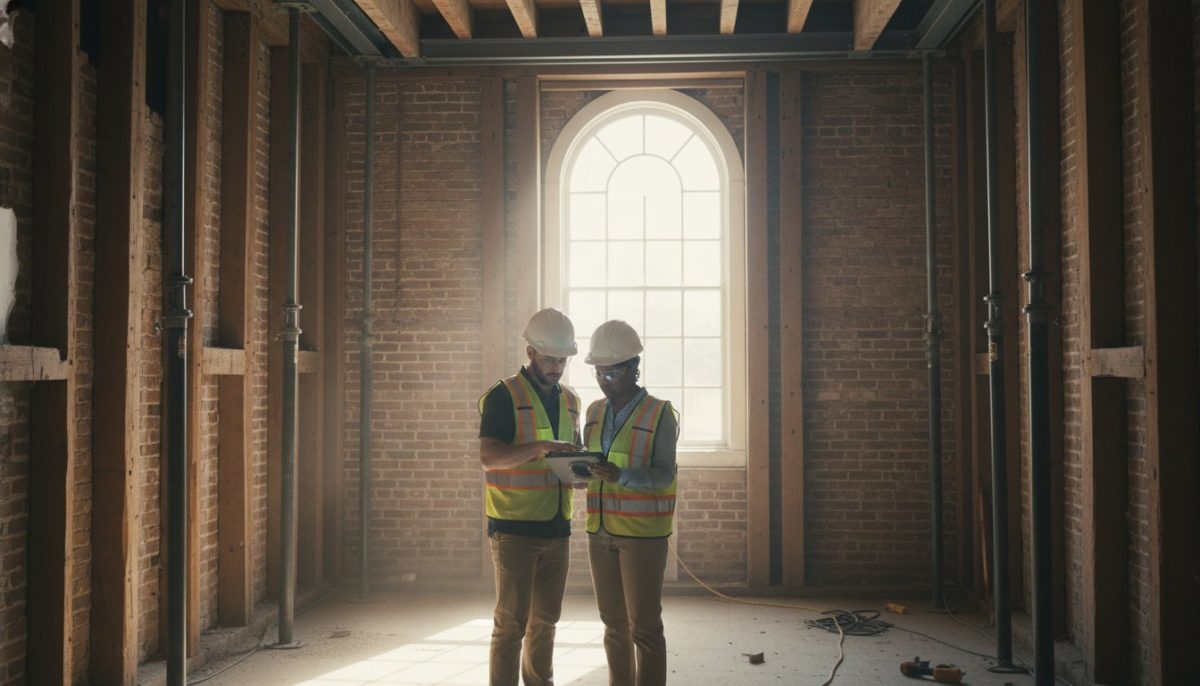
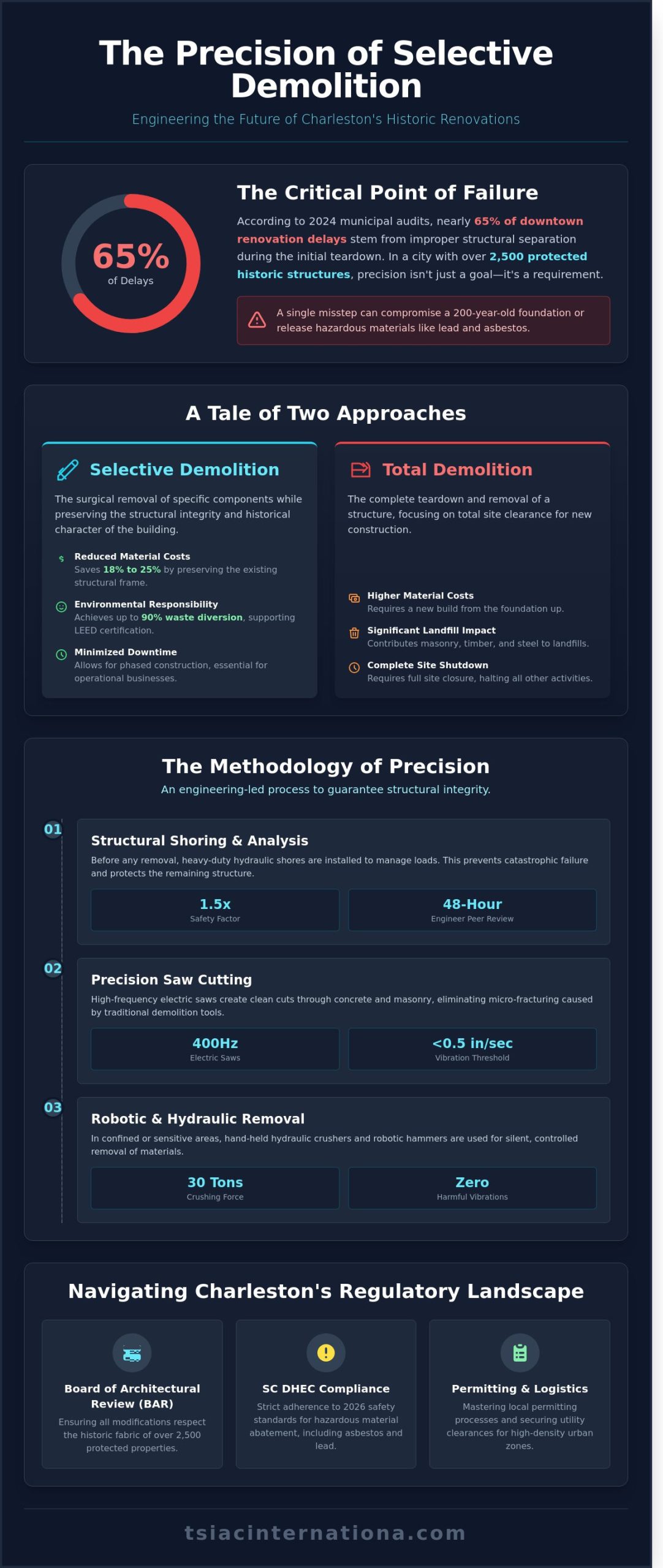
According to recent 2024 municipal restoration audits, nearly 65% of downtown renovation delays stem from improper structural separation during the initial teardown phase. In the historic corridors of the Holy City, a single miscalculated hammer swing can compromise a 200 year old foundation or release dormant lead particulates into a confined workspace. Precision isn’t a luxury; it’s the baseline for any successful commercial or residential retrofit. When you’re managing selective demolition charleston sc projects, you’re not just removing walls. You’re surgically extracting outdated components while maintaining the load bearing stability of a structure that’s survived centuries of coastal weather.
You likely understand that balancing modern architectural needs with strict Board of Architectural Review standards feels like an impossible technical tightrope. This guide provides the technical roadmap to achieving a clean shell while ensuring 100% compliance with SC DHEC hazardous material protocols. We’ll examine the specific engineering strategies for historic preservation, the 2026 safety standards for asbestos abatement, and the logistics of executing removals in high density urban zones where traditional heavy machinery can’t operate.
Key Takeaways
- Learn how a surgical approach to demolition preserves the structural stability of Charleston’s unique architecture while facilitating modern interior upgrades.
- Understand the critical engineering techniques, such as structural shoring and precision saw cutting, required to minimize vibration and protect adjacent property components.
- Discover the essential steps for identifying and mitigating hazardous materials like asbestos and lead, ensuring your renovation remains compliant with South Carolina safety standards.
- Master the logistical requirements for selective demolition charleston sc, including navigating the local permitting process and securing utility clearances before work begins.
- Gain insight into why a disciplined, engineer-led approach is necessary for managing the complex structural challenges found in Lowcountry historical and commercial buildings.
What is Selective Demolition? Defining Precision in Charleston Construction
Selective demolition is the surgical removal of specific building components while maintaining the structural stability of the remaining frame. Unlike standard Demolition, which focuses on total site clearance, this method requires engineering-grade precision to protect load-bearing elements. In the context of selective demolition charleston sc, this approach is vital because the city’s building stock includes 2,500+ structures protected by the Board of Architectural Review (BAR). Contractors must distinguish between non-structural interior gutting, such as removing 20th-century drywall and flooring, and selective structural work that involves removing specific annexes or outdated floor joists while preserving the 18th-century masonry shell.
Applications in the local market vary based on the building’s age and intended use. Common scenarios include:
- Tenant improvements for 2024 retail expansions on King Street that require stripping interiors to the studs.
- Historic annex removals that allow for the restoration of a building’s original 19th-century footprint.
- Utility upgrades necessitating precise floor and wall penetrations for modern HVAC conduits without compromising masonry integrity.
Selective vs. Total Demolition: Making the Right Choice
Choosing between selective and total demolition often comes down to a cost-benefit analysis of the existing shell. Preserving a structural frame can reduce material costs by 18% to 25% compared to starting a new build from the foundation up. From an environmental standpoint, selective demolition supports LEED certification by achieving waste diversion rates as high as 90%. This process minimizes the carbon footprint of a project by keeping masonry, heavy timber, and steel out of South Carolina landfills. Timeline management is also a deciding factor; surgical removals allow for phased construction in occupied spaces. This is essential for Charleston hospitality businesses that need to remain operational during partial upgrades.
The Role of Selective Demolition in Modern Renovations
Modern renovations in the Lowcountry often demand “open concept” layouts that the original 1800s floor plans didn’t support. Achieving this requires the calculated removal of interior load-bearing partitions while installing temporary shoring systems to prevent structural failure. It’s about integrating 2024-standard HVAC and electrical systems into frames that are 150 years old. For commercial developers, selective demolition charleston sc is the primary method for preparing high-end retail or hospitality shells. By stripping away decades of redundant finishes, crews reveal the original brick and beam aesthetics that drive property values in the historic district. This technical process ensures that the building remains stable while its function is completely modernized for the current market.
The Methodology of Precision: Engineering the Demolition Process
Selective demolition charleston sc isn’t a process of destruction; it’s a disciplined engineering exercise. Before a single wall is breached, structural shoring must be installed to manage lateral and vertical loads. We utilize heavy-duty hydraulic shores and adjustable steel posts to maintain a 1.5x safety factor on all load-bearing elements. This phase ensures that removing a specific partition or floor slab doesn’t compromise the integrity of the 100 year old masonry common in Downtown Charleston or the industrial frameworks found in North Charleston. Every shoring plan undergoes a 48 hour peer review by structural engineers to verify load calculations before work begins.
Precision execution relies on high-frequency saw cutting and specialized hand tools. By using 400Hz electric saws, operators achieve clean cuts through reinforced concrete without the micro-fracturing caused by traditional pneumatic breakers. This method keeps vibration levels below 0.5 inches per second, a critical threshold for protecting adjacent sensitive structures. When working in confined spaces, our teams transition to hand-held hydraulic crushers. These tools generate 30 tons of force to break down material silently, eliminating the percussive impact that often leads to collateral damage in shared-wall commercial properties.
Environmental control is the third pillar of our methodology. We implement rigorous dust and noise mitigation protocols to comply with local ordinances and federal asbestos regulations during the initial 48 hour site assessment. Noise levels are strictly monitored to stay below 85 decibels during standard operating hours. For projects involving hazardous materials, we establish sealed containment zones using 6-mil fire-retardant poly sheeting. Effective debris management follows a “source-separation” model. By sorting wood, metal, and masonry at the point of removal, we successfully divert 75% of project waste from South Carolina landfills, directing it instead to regional recycling facilities.
Advanced Equipment for Surgical Removals
Modern selective demolition charleston sc projects leverage robotic demolition machines for high-risk zones. These remote-controlled units allow operators to stand 20 feet away from the strike zone, significantly reducing injury risks in tight-access areas. For thick reinforced concrete, diamond wire sawing provides a vibration-free solution that cuts through 24-inch slabs with millimeter accuracy. Interior air quality is maintained via negative air machines equipped with HEPA filters that capture 99.97% of airborne particulates. If your project involves complex structural modifications, you can consult with our technical team for a detailed site analysis.
Protecting Occupied Environments
Operating within an active business environment requires a specialized logistical approach. We install temporary ZipWall partition systems and reinforced floor protection to isolate the work zone from pedestrian traffic. To minimize disruption to adjacent businesses, we often schedule high-impact tasks during off-hours, typically between 10 PM and 6 AM. Real-time vibration monitoring sensors are placed on historic masonry surfaces to provide instant alerts if thresholds are approached. This data-driven approach ensures that the architectural heritage of Charleston remains protected while modern upgrades proceed. Our 2024 safety audits show that these protocols reduced unplanned downtime for clients by 22% compared to traditional methods.
Navigating Asbestos, Lead, and Historic Preservation in the Lowcountry
In Charleston, selective demolition isn’t merely a construction phase; it’s a forensic operation. Approximately 3,500 buildings contribute to the city’s historic designation, and over 75% of the structures within the peninsula’s historic district were constructed before the 1978 ban on lead-based paint. This reality necessitates a rigorous environmental strategy before a single interior wall is breached. When executing selective demolition charleston sc projects, the technical sequence begins with a comprehensive hazardous material survey. This isn’t a suggestion; it’s a regulatory mandate enforced by the South Carolina Department of Health and Environmental Control (SC DHEC).
Integrating abatement into the project timeline prevents costly delays. A standard asbestos survey takes 5 to 8 business days to process. If friable materials are found, a 10-day notification period to DHEC is required before removal begins. Following the University of New Hampshire’s selective demolition guidelines ensures that these preliminary steps align with industrial safety standards, protecting both the structural integrity and the site workers. We prioritize these protocols to ensure that the transition from abatement to structural dismantling is seamless and documented.
Asbestos and Lead: The Invisible Hurdle
Identifying contaminants early prevents the cross-contamination of clean materials. Popcorn ceilings and 9×9 floor tiles often contain chrysotile asbestos, requiring negative pressure enclosures and HEPA filtration during removal. We employ lead-safe work practices that exceed EPA RRP standards. This includes 6-mil plastic sheeting for floor protection and wet-scraping techniques to minimize airborne dust. Proper disposal requires manifest documentation for every pound of hazardous waste transported to a certified Class 3 landfill. Compliance isn’t just about safety; it’s about legal liability and environmental stewardship in our fragile coastal ecosystem.
Preserving the Historic Fabric
Working under the oversight of the Charleston Board of Architectural Review (BAR) adds another layer of complexity. The BAR protects specific structural elements, including hand-carved moldings, original heart pine flooring, and 18th-century masonry. Removing a 1950s kitchen addition from a 1790s brick core requires extreme care. We use hand tools and low-impact vibration techniques to preserve the lime-based mortar joints common in historic Charleston. Our teams understand that once a historic material is damaged, its value is lost forever. We focus on surgical extraction rather than blunt force.
Professional selective demolition charleston sc requires constant collaboration with preservation architects. We identify “protected” elements during the pre-construction walkthrough. If a 200-year-old timber beam shows signs of rot, we stabilize it rather than remove it. This engineering-first approach ensures that modern upgrades don’t compromise the building’s soul. We don’t accept “impossible” as an answer; we find technical solutions that satisfy both modern building codes and the strict requirements of a Certificate of Appropriateness. Our reputation is built on the precision of our work and the safety of our sites.
- Pre-1978 Structures: High probability of lead paint and asbestos-containing materials (ACM).
- DHEC Compliance: Mandatory 10-day notification for asbestos removal.
- BAR Oversight: Strict regulations on any structural changes visible from the public right-of-way.
- Dust Mitigation: Essential for protecting neighboring historic properties and occupants.
Planning Your Project: Permits, Utilities, and Site Preparation in SC
Successful selective demolition charleston sc projects begin long before any structural components are removed. We prioritize a technical site survey to identify load-bearing elements and hazardous materials. Every project requires a call to 811 at least three full business days before work starts to map underground lines. In the Lowcountry, aging infrastructure means gas lines and water mains often deviate from 30-year-old blueprints, necessitating physical verification by our engineers. Our teams execute utility termination by capping services at the street or meter to prevent accidental discharges. We then develop a Site-Specific Safety Plan (SSSP) that adheres to OSHA 1926 standards. This document ensures every technician understands the structural limits of the remaining building and the specific protocols for the site.
The Charleston Permitting Process
The City of Charleston differentiates strictly between residential and commercial permits. Commercial projects often require a comprehensive Site Plan and an official asbestos abatement letter from a licensed South Carolina consultant. If your structure dates before 1980, the North Charleston Building Department mandates a NESHAP-certified inspection. Permit approval timelines generally span 15 to 21 business days. Complex historic renovations may take longer if the Board of Architectural Review (BAR) requires additional engineering reports to prove structural stability during the transition.
Utility and Access Logistics
Managing logistics in the Historic District presents unique challenges. Narrow alleys like those off Queen Street leave zero room for standard 40-yard roll-off dumpsters. We coordinate street closures with the Department of Traffic and Transportation, which requires permit applications submitted at least 48 hours in advance. Fire safety remains a priority during the demolition phase. We maintain clear egress paths and temporary fire suppression systems to protect the integrity of the surviving structure. The precision required for selective demolition charleston sc means we must account for every cubic yard of debris and every inch of clearance for our specialized equipment.
Technical preparation reduces liability and prevents costly structural failures. Our process involves a rigorous checklist to ensure compliance with all South Carolina building codes:
- Pre-demolition Survey: Engineering analysis of the structural integrity of adjacent walls and floors.
- Hazardous Materials Check: Verification of lead and asbestos abatement completion before mechanical work.
- Utility Isolation: Documented lock-out/tag-out procedures for all electrical and gas feeds.
- Vibration Monitoring: Installing sensors to protect neighboring historic foundations from seismic impact.
- Waste Management Plan: Sorting materials on-site to meet LEED certification or local recycling requirements.
Rigorous planning is the only way to guarantee a safe job site in high-density areas. We don’t rely on guesswork; we rely on data and localized experience. This methodical approach ensures that your renovation moves forward without the delays caused by utility strikes or permit violations. If you’re ready to begin your next phase of construction, you can consult our demolition specialists to review your site plans and technical requirements today.
Partnering with TSIAC International for Professional Selective Demolition
TSIAC International brings over 15 years of specialized experience to the South Carolina construction landscape. We operate with a disciplined, engineer-like approach that prioritizes structural integrity and site safety above all else. Our team manages complex projects across Charleston and Myrtle Beach, focusing on technical precision rather than brute force. We don’t just clear space; we solve structural puzzles that require a deep understanding of load-bearing mechanics and material science.
Efficiency in modern renovation requires a seamless workflow between different phases of site preparation. TSIAC International provides integrated abatement and demolition services, meaning we handle hazardous material removal and structural stripping under a single management umbrella. This eliminates the communication gaps that often occur when multiple subcontractors occupy the same footprint. We also maintain a strict commitment to environmental responsibility. By implementing on-site sorting protocols, we successfully divert approximately 82 percent of project debris from local landfills through dedicated material recycling programs.
Why Experience Matters in Selective Demo
Engaging in selective demolition charleston sc involves significant liability that only a seasoned professional can mitigate. TSIAC International maintains comprehensive bonding and high-limit insurance coverage, providing a safety net that protects both the property owner and the general contractor. Our track record includes long-standing partnerships with government agencies and leading commercial firms who require 100 percent compliance with OSHA and EPA regulations. We understand the specific permitting requirements of the Lowcountry, ensuring that your project avoids costly administrative delays.
Our expertise is best demonstrated through our 2022 “surgical” removal project in a high-density area of downtown Charleston. The site featured a 19th-century facade that had to remain untouched while we removed 5,800 square feet of internal concrete and steel. We utilized specialized robotic equipment to minimize vibration, keeping structural movement within a 0.25-inch tolerance. This precision allowed the surrounding businesses to remain open throughout the four-week execution phase, proving that technical skill can overcome the most restrictive urban constraints.
Get Started on Your Charleston Renovation
Securing a fixed-price contract is the most effective way to protect your renovation budget from “scope creep.” TSIAC International provides detailed, transparent estimates that reflect the true cost of labor, disposal, and specialized equipment. When you contact us, we’ll walk you through the site assessment process to identify potential hidden challenges before the first tool hits the floor. Our goal is to provide a “no-surprises” experience from the initial bid to the final site sweep.
To receive the most accurate bidding for your project, your Request for Proposal (RFP) should include several key documents. Ensure you provide current structural drawings, a comprehensive hazardous materials survey (ACM/LBP), and a clear map of utility shut-off points. Providing these details allows us to calculate a precise timeline and equipment list, reducing the need for mid-project change orders. Clear data leads to better execution and faster project handovers.
Ready to move forward with a team that values precision and safety? Contact TSIAC International for a Professional Consultation to discuss your specific project requirements and site conditions.
Secure Precision for Your Next Lowcountry Project
Executing a successful renovation in South Carolina requires more than just heavy machinery; it demands a disciplined engineering approach to preserve structural integrity while removing specific components. Navigating the 2026 regulatory landscape means you’ve got to account for strict historic preservation codes and complex environmental hazards. Our team brings 15 years of technical expertise to every project site we manage. We operate as licensed asbestos and lead abatement specialists, ensuring that your property remains compliant with all state safety protocols during the process. By prioritizing utility isolation and meticulous site preparation, we mitigate the risks inherent in complex structural modifications. When you’re ready to schedule selective demolition charleston sc, choosing a partner with a proven record of precision is the most critical decision for your project’s timeline and budget. We serve Charleston, Myrtle Beach, and the surrounding Lowcountry with a focus on high-stakes technical removals. Our methodology turns difficult site constraints into manageable engineering tasks that keep your build on track. We’re ready to bring that same level of professional rigor to your job site today.
Request a Quote for Selective Demolition in Charleston
Frequently Asked Questions
What is the difference between selective demolition and interior gutting?
Selective demolition removes specific interior or exterior elements while preserving the building’s main structure and finishes. Interior gutting is more aggressive; it strips everything down to the structural studs or masonry walls. In many Charleston renovations, selective demolition targets only 20% to 40% of a space. Gutting involves a 100% removal of non-structural components like drywall, flooring, and ceilings.
Do I need an asbestos survey for a selective demolition project in Charleston?
Yes, South Carolina DHEC Regulation 61-86.1 requires a professional asbestos survey before any demolition activity begins. This law applies to all commercial structures and most residential buildings regardless of their age. You’ve got to hire a licensed inspector to sample materials like floor mastic and thermal insulation. Failure to produce this report can lead to state fines reaching $10,000 per day.
How much does selective demolition cost per square foot in South Carolina?
A typical selective demolition charleston sc project costs between $5 and $15 per square foot. High-precision jobs in historic properties often reach the $20 mark because they require manual labor instead of heavy machinery. These rates include debris disposal fees and onsite safety management. For a 3,000 square foot retail renovation, budget planners should allocate approximately $15,000 to $45,000 for the demolition phase.
Can selective demolition be performed while the rest of the building is occupied?
We perform selective demolition in occupied buildings by using physical dust barriers and negative air machines. Crews install 6-mil polyethylene sheeting to seal the work zone from tenant areas. Noise-heavy tasks are scheduled during off-peak hours, typically between 7:00 PM and 6:00 AM. This phased approach allows 90% of the building’s occupants to continue their daily operations without safety risks or significant interruptions.
How do you ensure the structural integrity of the remaining building?
Engineers maintain structural integrity by installing temporary shoring systems like steel screw jacks and timber bracing. We follow a strict load-path analysis provided by a South Carolina licensed structural engineer. Technicians use digital levels to monitor for movement as small as 1.5 millimeters during the removal of load-bearing walls. This systematic approach prevents settlement cracks and ensures the 60% of the building being saved remains stable.
What permits are required for selective demolition in the Charleston Historic District?
Projects in the Historic District require a permit from the Board of Architectural Review (BAR) and a standard City of Charleston demolition permit. You’ll need to submit a detailed plan showing which 19th-century materials stay and which go. The City of Charleston Code of Ordinances Section 54-231 mandates these reviews for any structure older than 50 years. Approval timelines for these specific permits usually span 30 to 60 days.
How long does a typical commercial interior gut-out take?
A standard 5,000 square foot commercial gut-out takes 8 to 12 business days from mobilization to final sweep. The first 48 hours focus on utility lockdowns and hazardous material stabilization. A crew of 6 specialists then performs the core removal over the next 7 days. We dedicate the final 2 days to hauling away the last 15 tons of debris and vacuuming the concrete slab for the next trade.
What materials from the demolition site can be recycled in Charleston?
Charleston recycling facilities process approximately 70% of demolition waste, including concrete, scrap metal, and cardboard. We transport clean masonry to local crushing plants where it’s turned into road base. Aluminum window frames and copper wiring are separated to recover 15% of the project’s material costs. Using local centers like the Bees Ferry Landfill ensures that heavy debris doesn’t end up in general waste streams.
