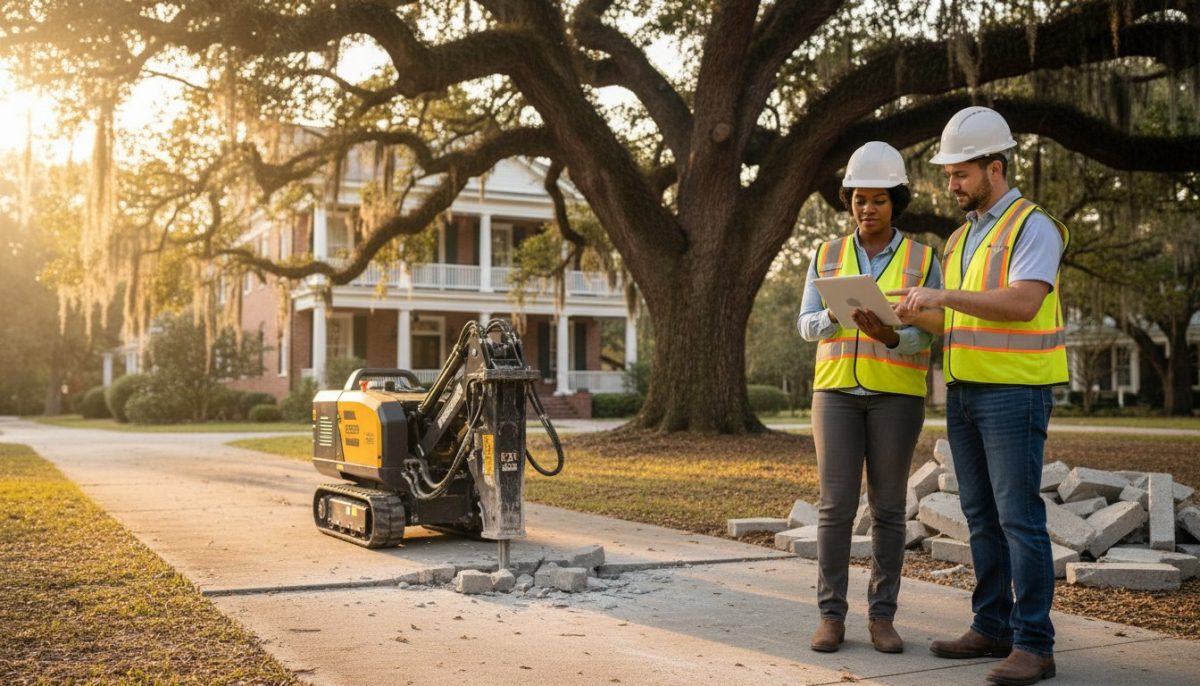
In the Charleston peninsula, approximately 42% of pre-1978 structures harbor legacy hazardous materials that can escalate a standard teardown budget by $4,500 or more without warning. Most developers realize that calculating the cost of demolition charleston sc requires more than a simple square footage estimate. You are likely aware that the intersection of strict Board of Architectural Review mandates and the logistical constraints of coastal debris management creates a complex financial landscape. It is frustrating to face project delays or budget overruns because a site assessment missed a critical regulatory detail or a hidden asbestos deposit.
This guide delivers a transparent, data-driven breakdown of 2026 pricing models to help you establish a predictable budget for residential and commercial site clearances. We provide the technical clarity needed to manage hazardous material abatement legally while navigating the specific permitting timelines required by the City of Charleston. You will find a detailed analysis of current disposal fees at regional facilities and a step by step overview of the structural safeguards necessary for work in high density historic districts. By the end of this report, you will have the professional confidence to move from site evaluation to active demolition with complete financial and regulatory certainty.
Key Takeaways
- Understand how Charleston’s unique coastal geography and site accessibility influence mobilization fees and overall project logistics.
- Navigate the current market to determine the cost of demolition charleston sc, with specific price-per-square-foot benchmarks for both residential and commercial structures.
- Identify critical legal requirements for asbestos and lead surveys to prevent costly environmental liabilities and project delays in older Lowcountry properties.
- Streamline your project timeline by mastering the localized permitting process and implementing essential safety protocols like silt barriers and dust suppression.
- Learn to evaluate quotes with engineering precision to avoid the risks of “low-ball” estimates and ensure structural integrity through expert execution.
Key Factors Influencing the Cost of Demolition in Charleston, SC
Estimating the cost of demolition charleston sc requires a technical assessment of three primary variables: total square footage, structural material density, and site-specific logistics. Charleston’s unique coastal geography introduces specific challenges for heavy machinery transport. Mobilization fees often account for 10% to 15% of a project’s total budget because the Lowcountry’s marshy terrain and high water table demand specialized transport equipment for heavy excavators and loaders. Project managers must evaluate these environmental factors alongside the physical attributes of the building to provide an accurate quote.
Contractors distinguish between “soft demo,” which involves stripping interior non-structural components like drywall and flooring, and “hard demo,” which refers to the total structural teardown of the building envelope. A standard Demolition project in South Carolina must also account for the age of the structure. Buildings constructed before 1978 have an 85% higher probability of containing lead-based paint or asbestos. These hazardous materials necessitate specialized abatement protocols that can increase the final invoice by $2,500 to $15,000, depending on the contamination levels and the total area requiring remediation.
Structure Size and Material Complexity
Residential wood-frame units typically cost between $5 and $15 per square foot. In contrast, commercial structures built with reinforced concrete and structural steel require hydraulic shears and high-reach excavators, pushing costs toward the $20 to $35 per square foot range. Multi-story demolitions involve 25% higher labor rates due to the increased safety risks and the need for sequential deconstruction. Foundation type plays a critical role; removing a 4-inch concrete slab is significantly more labor-intensive than clearing a traditional crawl space, often adding $2,000 to $5,000 to the site clearing phase.
Site Accessibility and Mobilization
Logistics in the French Quarter or Downtown Charleston present extreme constraints. Narrow streets, some measuring less than 15 feet wide, prevent the use of standard 30-yard roll-off containers. This forces crews to use smaller 10-yard trucks, which increases hauling frequency by 300%. Mobilization fees for bringing skid steers and specialized attachments to the Lowcountry vary based on the distance from industrial hubs. Proximity to recycling centers in North Charleston is a major cost driver. Projects located within a 10-mile radius of the Bees Ferry Landfill or North Charleston processing plants benefit from lower fuel surcharges and reduced drive-time labor costs.
Precise planning ensures that the cost of demolition charleston sc remains within the projected 2026 budget. Engineering-grade site assessments allow for the identification of underground utilities and soil stability issues before the first bucket hits the ground. By analyzing these factors with mathematical precision, developers can mitigate the risk of mid-project price spikes and ensure a clean transition to the construction phase.
Residential vs. Commercial Demolition: 2026 Pricing Breakdown
Estimating the cost of demolition charleston sc requires a clear distinction between residential and commercial scopes. In the 2026 market, pricing typically ranges from $4 to $15 per square foot. This wide variance isn’t arbitrary. It reflects the technical complexity of the structure and the specific safety protocols required for the site. Larger projects often benefit from the economy of scale. While a 500 square foot garage might cost $18 per foot due to minimum mobilization fees, a 50,000 square foot industrial warehouse can drop to $3 or $4 per foot because the heavy equipment transport costs are distributed across a larger area.
Residential Demolition Costs
For a standard 2,000 square foot single-family home in the Charleston area, owners should expect total removal costs between $14,000 and $32,000. This price includes the structure’s teardown, foundation removal, and debris hauling. Smaller structures like detached garages or sheds generally cost between $3,000 and $7,500. Local municipalities in Charleston and Mount Pleasant have strict requirements for utility capping. You’ll need to budget an additional $2,000 to $5,000 to have licensed professionals safely disconnect and seal water, sewer, and electrical lines at the street main before work begins.
The cost of demolition charleston sc also changes based on the project’s final goal. Total site clearing, where the land is scraped clean for new construction, is often more cost-effective than “renovation-ready” selective demolition. In selective demo, crews must manually strip interiors while protecting the home’s structural bones. This surgical approach increases labor hours by approximately 40% compared to a mechanical total knockdown. Our teams prioritize the preservation of load-bearing elements to ensure the building remains stable throughout the transition.
Commercial Interior Gutting and Selective Demo
Commercial projects in Charleston’s retail and office sectors demand a different level of engineering precision. Retail gut-outs for tenant improvements typically range from $6 to $13 per square foot. This process involves the systematic removal of acoustic drop ceilings, metal stud framing, and heavy commercial flooring like epoxy or glued-down carpet. Industrial warehouses are less expensive per foot, often staying between $2.50 and $5.50, because they lack the intricate finishes found in professional office suites or healthcare facilities.
Safety and compliance are the highest priorities in commercial environments. For any structure built before 1990, federal law requires a thorough inspection to follow Asbestos Laws and Regulations. If hazardous materials are found, abatement costs will be calculated separately from the standard demolition fee. TSIAC International excels in these high-stakes scenarios, utilizing specialized dust suppression and vibration monitoring to protect adjacent businesses during the process. We don’t just clear space; we manage the technical risks that come with complex urban environments.
If you’re managing a project that requires specialized industrial expertise and surgical precision, choosing a partner with a proven safety record is the most effective way to protect your investment.
The Impact of Asbestos and Lead Abatement on Project Budgets
Hazardous material remediation represents the most significant variable in the total cost of demolition charleston sc. While structural tearing and debris removal follow predictable mechanical patterns, the discovery of legacy toxins introduces rigid regulatory timelines and specialized labor requirements. In the Charleston market, approximately 68% of residential structures built before 1980 contain some form of regulated hazardous material. These elements cannot be handled by standard demolition crews. They require surgical precision and environmental controls that can increase a baseline budget by 25% to 50% depending on the volume of material identified.
South Carolina DHEC Regulation 61-86.1 mandates a certified asbestos survey for all commercial demolitions and most residential projects regardless of the building’s age. This is a non-negotiable legal threshold. Skipping this step results in immediate stop-work orders and fines that often exceed $10,000 per violation. A professional survey for a standard 2,500-square-foot property typically costs between $800 and $1,500. This initial investment provides the technical roadmap for the entire project. It identifies whether materials are friable, meaning they can be crumbled by hand pressure, or non-friable, which dictates the level of containment required during the process.
The financial weight of abatement stems from the rigorous containment protocols. Contractors must establish “negative pressure” environments using HEPA-filtered air scrubbers to prevent microscopic fibers from migrating into the Charleston humidity. Specialized labor for these tasks costs roughly $75 to $120 per man-hour, nearly double the rate of general demolition labor. Every square foot of the work area must be sealed with 6-mil reinforced poly-sheeting. Once the materials are removed, they cannot be sent to standard municipal landfills. South Carolina facilities, such as the Bees Ferry Landfill or specialized Class 3 sites, apply heavy surcharges for toxic waste. Disposal fees for asbestos-contaminated debris often reach $150 per ton, compared to the $45 to $60 per ton charged for clean construction and demolition waste.
Asbestos Abatement Service Fees
Removal costs generally range from $8 to $15 per square foot for “wet method” removal, which is the standard for localized interior work. Dry removal is rarely permitted and requires specific DHEC emergency authorization due to the extreme dust risks. In Charleston’s historic and mid-century districts, asbestos is frequently embedded in 9-inch vinyl floor tiles, transite siding, and mag-block pipe insulation. Utilizing DHEC-certified contractors is the only way to ensure the final air clearance passes inspection, allowing the cost of demolition charleston sc to remain within the projected contingency fund.
Lead Paint Remediation Costs
For residences built prior to 1978, the EPA’s Renovation, Repair, and Painting (RRP) Rule governs how lead-based paint is managed. Lead-safe work practices add roughly 15% to the labor timeline because crews must use specialized HEPA vacuums and wet-scraping techniques to minimize dust. Debris management becomes more complex as lead-contaminated wood and plaster must be wrapped in plastic before transport. A final clearance test, involving dust wipe samples analyzed by a third-party lab, costs approximately $300 to $500. This ensures the site is safe for the subsequent reconstruction phase.
Permitting, Site Prep, and Debris Management in the Lowcountry
The administrative and preparatory phase of a project significantly dictates the final cost of demolition charleston sc. You can’t simply swing a wrecking ball without a rigorous sequence of approvals and site controls. In Charleston and North Charleston, the process begins with a mandatory 10 day notice to the South Carolina Department of Health and Environmental Control (DHEC) regarding asbestos abatement. This is a non-negotiable legal requirement. Local permit fees typically range from $150 to $600 for standard residential structures, but large scale commercial projects scale their fees based on total project valuation. Detailed site plans must be submitted to avoid utility disruptions, as hitting an unmarked water line in the peninsula’s dense soil can lead to $10,000 in immediate repair fines.
Charleston Demolition Permits and Regulations
The Board of Architectural Review (BAR) oversees any structure over 50 years old within the historic districts. This oversight adds 4 to 12 weeks to your project timeline. You’re required to post a “Notice of Demolition” sign on the property at least 15 days before work begins to inform the public. If your site is in the BAR-L or BAR-S zones, expect a public hearing. These delays aren’t just bureaucratic hurdles; they represent a $1,200 to $2,000 daily overhead in equipment rentals and security if not managed with precision.
Site safety is the next major budget line item. Lowcountry terrain requires specific silt fencing and erosion controls to meet the 2026 updated stormwater management standards. Perimeter fencing costs roughly $4.25 per linear foot, while silt barriers are essential to prevent runoff into the marsh or city drainage systems. Dust suppression is equally critical in the humid Charleston climate. We use high pressure misting systems to keep particulates from migrating to neighboring properties. This ensures OSHA compliance and prevents “stop work” orders from city inspectors that can derail a schedule by weeks.
Recycling and Environmental Responsibility
TSIAC prioritizes material recovery to lower your bottom line and reduce landfill impact. Sorting metal, clean wood, and aggregates on-site can reduce landfill tipping fees by 35% to 45%. While traditional “smash and haul” is faster, deconstruction allows for the salvage of high value materials like historic heart pine beams or Charleston Grey brick. These materials often find a second life in luxury renovations, providing a credit that offsets the labor intensive nature of the work. This method is essential for modern SC projects aiming for LEED certification.
Concrete disposal is another major expense that requires a strategic approach. Hauling heavy slabs to the Bees Ferry Landfill costs approximately $575 per 30 yard dumpster in 2026, excluding the labor to load it. However, on-site crushing transforms waste into usable structural fill. By utilizing a mobile jaw crusher, we turn old foundations into GABC (Graded Aggregate Base Course). This eliminates transport fees and provides a stabilized base for your next construction phase. This technical approach is one reason the cost of demolition charleston sc varies so widely between standard contractors and specialized engineering firms.
Effective debris management isn’t just about cleaning up; it’s about logistical efficiency. We coordinate the timing of roll off dumpsters to ensure no more than two containers sit on a tight downtown lot at once. This prevents traffic congestion and minimizes the risk of city citations. Our team tracks every ton of waste, providing you with a final report that details the diversion rate from South Carolina landfills. This level of transparency is a hallmark of our professional commitment to the Lowcountry’s environment.
Getting an Accurate Quote: Why TSIAC International is the Strategic Choice
Low-ball estimates often hide toxic financial risks. In the South Carolina Lowcountry, failing to account for asbestos, lead-based paint, or contaminated soil can result in EPA fines that exceed $25,000 per daily violation. Since 2009, TSIAC International has executed complex structural and selective demolition projects across South Carolina, prioritizing transparent engineering over bottom-tier bidding. We provide fixed-price contracts to eliminate the hidden fee culture that plagues the construction industry. This disciplined approach ensures that your final cost of demolition charleston sc stays within the initial budget, whether you’re clearing a small residential lot or gutting a 60,000-square-foot industrial facility. We operate as a single-source partner, managing hazardous material abatement, interior gutting, and total structural removal under one roof. This integration prevents the common scheduling conflicts that typically delay local projects by 14 to 20 days when multiple subcontractors are involved.
Our 15-year history in the region has taught us that Charleston’s unique geography requires more than just a wrecking ball. High water tables and historic preservation requirements demand a surgical approach to structural removal. We don’t just knock buildings down; we deconstruct them with a focus on site stability and environmental compliance. By choosing a partner that understands the local regulatory landscape, you mitigate the risk of stop-work orders that can stall a development for months. We’ve built our reputation on the fact that we don’t promise the impossible. We deliver results based on calculated technical data and proven field experience.
The TSIAC Professional Advantage
Control over the heavy equipment supply chain is vital for maintaining project timelines. We own our entire fleet of high-reach excavators and specialized hydraulic attachments; we don’t rely on third-party rental availability or fluctuating market rates. This vertical integration reduces mobilization expenses by approximately 12% for our clients. Our safety protocols are backed by comprehensive insurance coverage, protecting property owners from liability during high-risk operations. We manage the entire lifecycle of the project, beginning with initial hazardous material testing and concluding with final site grading. This start-to-finish service ensures the land is ready for immediate redevelopment without requiring additional earthmoving contractors.
Requesting Your Charleston Demolition Estimate
Precision requires specific data. To provide a rapid and accurate quote, our team needs the building’s total square footage, the original construction date, and clear site access points. Projects built before 1978 require specific lead-paint and asbestos protocols that directly influence the total cost of demolition charleston sc. A physical site walk-through remains a non-negotiable step in our process. This allows our engineers to identify structural challenges, such as shared footings with adjacent buildings or abandoned underground storage tanks. Identifying these variables early prevents 95% of mid-project change orders. If you’re ready to secure your site with a team that values technical accuracy over sales talk, it’s time to move forward. Get a detailed demolition quote from TSIAC International to begin your project with engineering-grade precision and total cost certainty.
Securing Your Lowcountry Project’s Success
Navigating the cost of demolition charleston sc requires a strategic approach that accounts for 2026 labor projections and strict DHEC disposal protocols. Successful projects depend on more than just a wrecking ball; they require precise planning for lead abatement and structural integrity. TSIAC International brings over 15 years of Lowcountry experience to every job site. Our team consists of DHEC-certified hazardous material specialists who manage complex environmental risks before they become budget liabilities. We maintain full licensing and insurance for both structural and selective demolition, ensuring your property is cleared with engineering precision. Whether you’re managing a residential teardown or a 50,000-square-foot commercial overhaul, technical expertise is the only way to prevent unforeseen delays. Don’t leave your project’s safety or your financial timeline to chance. We provide the disciplined execution and specialized equipment needed for a clean slate. Your site is ready for its next chapter when the groundwork is handled by professionals who understand Charleston’s unique coastal terrain.
Contact TSIAC International for a Free Demolition & Abatement Quote
We look forward to helping you clear the way for your next major investment with confidence and safety.
Frequently Asked Questions
How much does it cost to demolish a 2,000 sq. ft. house in Charleston?
Demolishing a 2,000 sq. ft. house in Charleston costs between $12,000 and $22,000 as of 2026. This range reflects the current local rate of $6 to $11 per square foot for residential structures. The final cost of demolition charleston sc fluctuates based on site accessibility for heavy machinery and the volume of debris generated during the teardown.
Site preparation and mobilization of hydraulic excavators typically account for 15% of the total project budget. If the property is located in high-density areas like the Peninsula, logistics and traffic control measures can increase the final invoice by another 10%.
Do I need an asbestos survey before demolishing my home in South Carolina?
Yes, South Carolina DHEC Regulation 61-86.1 requires a professional asbestos survey for any structure scheduled for demolition. You’ve got to hire a licensed inspector to evaluate the building if the footprint exceeds 160 square feet. This rule applies regardless of the home’s original construction date to ensure environmental safety.
The state requires the submission of a “Notice of Demolition” at least 10 working days before any physical work begins. Failure to provide a valid survey and notification results in administrative fines that often start at $1,000 per day of non-compliance.
How long does the typical residential demolition take in Charleston?
A typical residential demolition in Charleston takes 3 to 7 business days for the physical teardown and site clearing. The entire project lifecycle is longer, usually spanning 25 to 40 days when including administrative requirements. You’ll spend roughly 14 days waiting for utility “kill letters” from providers like Dominion Energy before a permit is issued.
Municipal permit processing adds another 10 days to the schedule. During the 4-month peak of hurricane season, contractors often build in a 20% buffer to account for weather-related site closures and saturated soil conditions that prevent heavy equipment operation.
What is the difference between selective demolition and a total gut-out?
Selective demolition involves the surgical removal of specific structural elements while a total gut-out strips every interior component down to the framing. Selective projects usually target 25% to 40% of the building, such as removing a single wing or specific partition walls. It’s a precision-based approach that requires careful shoring of remaining structures.
A total gut-out is a 100% clearance of all interior finishes, including drywall, flooring, and mechanical systems. This process prepares the building’s skeleton for a complete architectural reconfiguration. While a gut-out is faster to execute, it requires comprehensive debris management plans to handle the high volume of mixed materials.
Are there extra fees for demolishing concrete driveways or foundations?
Removing concrete driveways or foundations adds $1,500 to $4,500 to the total cost of demolition charleston sc. Standard 4-inch reinforced concrete costs approximately $2.50 per square foot to break and haul away. These fees cover the use of specialized hydraulic breakers and the higher tipping charges at local landfills for heavy materials.
If the foundation includes deep footings or commercial-grade 8-inch slabs, disposal costs increase by 35%. Heavy loads require specialized tri-axle dump trucks, and many facilities charge a premium for concrete that contains high amounts of rebar or mesh reinforcement.
Is recycling of demolition debris required in Charleston, SC?
Charleston doesn’t strictly mandate 100% recycling for private residential demolition, but local regulations prioritize the diversion of 5 specific material classes. The Bees Ferry Landfill enforces sorting protocols for clean concrete, scrap metal, and untreated wood. These efforts help the county work toward its 40% waste reduction target for construction materials.
Contractors who utilize specialized recycling centers often reduce their overhead. Tipping fees for sorted, recyclable debris are typically $15 to $25 lower per ton than mixed-waste disposal fees. This economic incentive encourages professional firms to implement on-site sorting processes for every major project.
Can I save money by doing the interior demolition myself?
You can save approximately 10% to 15% of your total budget by performing the interior demolition yourself. For a standard 2,000 sq. ft. home, this equates to a $2,000 to $3,500 reduction in professional labor costs. You’ll still need to budget for 20-yard dumpster rentals and appropriate safety equipment to manage the debris.
It’s important to realize that 18% of DIY demolition projects result in accidental damage to load-bearing walls or active plumbing lines. These errors often lead to emergency repair costs that exceed the initial savings. Professional oversight ensures that utility disconnects are verified before any walls are breached.
What permits are required for commercial demolition in North Charleston?
Commercial demolition in North Charleston requires a specific Demolition Permit from the City Building Department alongside a DHEC Form 3430. You must provide a site safety plan, certified asbestos survey results, and utility abandonment letters. The city also requires a $1,000,000 minimum liability insurance certificate from the primary contractor.
Permit fees are calculated at a rate of $7 per $1,000 of the project’s estimated value. There’s also a standard $50 administrative filing fee for all commercial zones. If the project involves land disturbance over one acre, you’ll need additional stormwater management permits to comply with local environmental codes.