
Approximately 40,000 people in the United States die every year from diseases linked to a mineral that many assumed was a problem of the past. While the EPA’s 2024 ban finalized the phase-out of chrysotile asbestos gaskets by May 28, 2026, the legacy of this indestructible material remains embedded in millions of residential and commercial structures. You’re likely concerned about how past exposure or current building materials might impact your long-term well-being, and that uncertainty is a heavy burden to carry. Understanding asbestos exposure health risks requires looking beyond the surface at the unique aerodynamics of fibers that the human body simply cannot break down.
We’ve developed this guide to provide a methodical analysis of the medical and safety realities you face. You’ll gain a clear understanding of the distinctions between mesothelioma, asbestosis, and lung cancer, along with the critical 10 to 50 year latency period that defines these conditions. We’ll also outline the technical protocols for identifying dangerous materials and why professional abatement is a medical necessity rather than just a regulatory requirement. By the end of this article, you’ll have the technical knowledge required to manage these risks with precision and professional confidence.
Key Takeaways
- The microscopic aerodynamics of fibers lead to long-term asbestos exposure health risks because these invisible particles are indestructible within the human body.
- Asbestos-related diseases feature a 10 to 50 year latency period where the cumulative dose-response relationship dictates long-term medical outcomes.
- Structures built before the 1980s frequently contain asbestos-containing materials (ACMs) that pose a higher risk when disturbed than when remaining intact.
- Professional abatement involves rigorous technical protocols, including negative air pressure and poly-sheeting containment, to eliminate hazards at the source.
- It’s essential to differentiate between respiratory conditions to determine the appropriate mitigation steps for suspected hazards in commercial and residential properties.
Understanding Asbestos Exposure Health Risks and Fiber Behavior
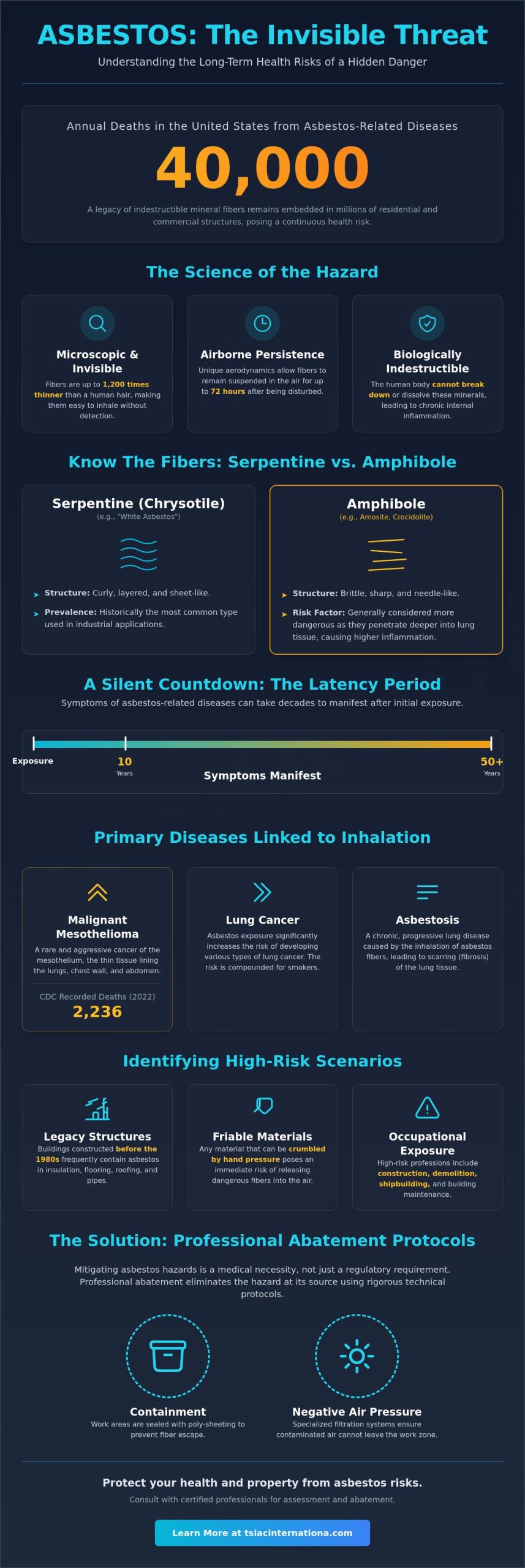
Asbestos isn’t a single substance but a group of six naturally occurring silicate minerals valued historically for their extreme tensile strength and thermal resistance. For a comprehensive overview of asbestos, one must examine its mineralogical properties and industrial legacy. These fibers are microscopic, often 1,200 times thinner than a human hair. Because they’re invisible to the naked eye, workers and residents frequently don’t realize they’re inhaling or ingesting these hazardous particles during routine activities. The physical behavior of these minerals is what drives the severity of asbestos exposure health risks.
Unlike heavier dust particles that settle quickly, asbestos fibers possess unique aerodynamics. When materials are disturbed during structural demolition or interior gutting, these fibers can remain suspended in the air for up to 72 hours. Their light weight and thin profile mean even minor air currents keep them buoyant in the breathing zone. Once these fibers enter the body, the natural defense mechanisms, such as coughing or ciliary action, are often insufficient to expel them. These minerals are chemically inert and physically indestructible; the human body simply doesn’t have the biological tools to break them down or dissolve them. This permanent presence leads to chronic internal irritation.
The Difference Between Serpentine and Amphibole Fibers
Chrysotile, often called “white asbestos,” belongs to the serpentine family and features a curly, sheet-like structure. It was the most common form used in industrial applications, including the gaskets that are being phased out by May 28, 2026. In contrast, amphibole fibers like Amosite and Crocidolite are needle-like and brittle. This rigid, spear-shaped geometry allows them to penetrate deeper into the lung tissue and the mesothelium. The specific shape of the fiber dictates the severity of tissue scarring; the needle-like amphiboles are generally more resistant to clearance and cause higher levels of cellular inflammation.
Primary Exposure Pathways in 2026
Occupational exposure remains a primary concern in 2026, especially for those working in construction, shipbuilding, and demolition. Professionals involved in selective demolition or concrete removal often encounter legacy materials that were installed decades ago and have now become unstable. Environmental exposure also occurs when naturally occurring deposits are disturbed or when deteriorating building components release fibers into the air. Friable asbestos is defined as any material that can be crumbled, pulverized, or reduced to powder by hand pressure, which immediately releases dangerous fibers into the environment. Identifying these pathways is the first step in establishing a controlled, safe environment for both workers and occupants.
Primary Diseases Linked to Asbestos Inhalation
Medical science defines the severity of asbestos exposure health risks through a “dose-response” relationship. This principle dictates that the total concentration of fibers inhaled, combined with the duration of exposure, directly determines the probability of developing a life-threatening illness. Because the human body lacks the biological mechanisms to break down these silicate minerals, every fiber inhaled contributes to a cumulative internal burden. This biological persistence triggers chronic inflammation and cellular mutation over time.
The most deceptive characteristic of these diseases is the extended latency period. Symptoms rarely appear immediately; instead, they often take 10 to 50 years to manifest after the initial exposure occurred. This delay means that many individuals diagnosed today were exposed decades ago in unregulated environments. Current data for 2026 shows that approximately 40,000 people in the U.S. die annually from asbestos-related conditions. In 2022, the CDC specifically recorded 2,236 deaths from mesothelioma. Adhering to OSHA asbestos safety standards is the only methodical way to prevent these long-term medical outcomes during modern construction or renovation projects.
Malignant Conditions: Mesothelioma and Lung Cancer
Mesothelioma is a rare and aggressive form of cancer that develops in the thin layer of tissue covering the internal organs, known as the mesothelium. It most commonly affects the lining of the lungs (pleura) but can also occur in the abdomen (peritoneum). Asbestos fibers also function as a direct carcinogen within pulmonary tissue, significantly increasing the risk of lung cancer. Beyond the respiratory system, evidence continues to link asbestos inhalation to malignant growths in the larynx, ovaries, and gastrointestinal tract.
Chronic Non-Cancerous Diseases
Asbestosis is a serious, progressive condition characterized by the scarring of lung tissue, also known as fibrosis. This scarring occurs as the body’s immune system attempts to attack the indestructible fibers, resulting in permanent damage that makes the lungs stiff and restricts oxygen exchange. Many patients also suffer from pleural disease, which involves the thickening of the membrane surrounding the chest cavity. If you suspect your building contains legacy materials that could be disturbed, professional asbestos abatement is the required standard to ensure these fibers don’t become airborne. You should monitor for the following clinical symptoms:
- Shortness of breath, especially during physical exertion
- A persistent, dry, and non-productive cough
- Tightness or chronic pain in the chest area
- A crackling sound in the lungs when breathing in
Variables That Influence Individual Asbestos Health Risks
The severity of asbestos exposure health risks is not uniform across all individuals; it’s determined by a complex interplay of environmental and biological variables. While the presence of fibers is the catalyst, the clinical outcome depends on the specific circumstances of the encounter and the physiological resilience of the person involved. Methodical risk assessment must account for these factors to determine the urgency of medical monitoring or the necessity of immediate abatement in a facility.
Dose remains the most critical predictor of future illness. This includes both the concentration of fibers in the breathing zone and the total duration of the exposure event. The National Cancer Institute provides data on asbestos exposure and cancer risk, confirming that while longer exposure increases danger, the EPA and WHO maintain there is no safe level of asbestos exposure. Even brief, high-intensity incidents, such as the uncontrolled disturbance of insulation during interior gutting, can introduce a sufficient fiber load to trigger cellular damage decades later. Individual factors like age at the time of exposure and genetic predisposition also influence how effectively the body manages the resulting chronic inflammation.
The Synergistic Effect of Smoking
Smoking creates a synergistic effect that drastically alters the risk profile for lung cancer. Tobacco smoke paralyzes the cilia, the microscopic hair-like structures responsible for sweeping foreign particles out of the respiratory tract. When these clearance mechanisms are compromised, asbestos fibers remain trapped in the pulmonary tissue for longer periods. Statistically, smokers exposed to asbestos don’t just face a slightly higher danger; they’re significantly more likely to develop lung cancer than non-smokers with identical exposure levels. Smoking cessation is the most critical intervention for any individual with a known history of asbestos inhalation.
Secondary and Take-Home Exposure Risks
Secondary or “take-home” exposure represents a critical gap in public awareness and a significant historical cause of illness in non-workers. Fibers are notoriously persistent and easily attach to clothing, skin, and hair. Historically, family members of workers in the shipbuilding and construction sectors developed mesothelioma simply by breathing in dust released during the laundering of contaminated work clothes. To mitigate these asbestos exposure health risks in modern settings, professional abatement teams utilize rigorous decontamination showers and specialized vacuum systems. These technical protocols ensure that hazardous minerals don’t leave the regulated work area, protecting both the workers and their households from cross-contamination.
Identifying and Assessing Asbestos Hazards in Structures
Identifying asbestos exposure health risks within a property is a technical challenge because the mineral is often integrated into the very fabric of the building’s infrastructure. In many commercial and residential structures built before the 1980s, asbestos exists in a “silent” state. As long as these materials remain intact and undisturbed, they generally don’t pose an immediate threat to the occupants. The danger escalates dramatically during “trigger events” such as structural demolition, interior gutting, or even natural deterioration caused by flooding. Visual inspection is fundamentally insufficient for identification; laboratory analysis is the only way to confirm a material’s mineral composition. Professional assessment involves taking physical samples under controlled conditions to avoid accidental fiber release during the testing process itself.
Common Household and Commercial ACMs
The variety of Asbestos-Containing Materials (ACMs) used in the 20th century is extensive, covering nearly every functional component of a building. Thermal insulation is a primary concern, including white, fibrous pipe wrap, boiler jackets, and the textured “popcorn” ceilings common in mid-century attics. Flooring and roofing materials are also frequent culprits. Vinyl floor tiles, the black mastic adhesives used to secure them, and various felt roofing shingles often contain significant asbestos concentrations. Wall and structural components aren’t exempt either. Joint compounds, traditional plaster, and cement siding panels were frequently manufactured with asbestos to improve fire resistance and durability. Even the concrete removal process can be hazardous if the concrete was reinforced with asbestos fibers or poured over asbestos-containing insulation.
The Dangers of DIY Disturbance
When an untrained individual attempts to sand, drill, or saw through an asbestos-containing matrix, they create a localized cloud of invisible fibers. These sub-micron particles are too small for a standard N95 dust mask to filter out; the fibers simply pass through or around the seal, entering the lungs directly. This uncontrolled release is precisely how asbestos exposure health risks transition from a theoretical possibility to a medical reality. The aerodynamic properties of these fibers allow them to migrate through HVAC systems, contaminating entire buildings within minutes. In commercial settings, improper handling also carries significant legal liabilities and can result in the total closure of a facility. If you suspect your building contains hazardous materials, scheduling a professional asbestos abatement is the only methodical way to ensure the safety of the occupants and the long-term integrity of the structure.
Professional Abatement: The Standard for Mitigating Health Risks
Managing asbestos exposure health risks requires more than simple avoidance; it demands a technical intervention that permanently removes the source of the hazard from the environment. Professional contractors act as the primary line of defense, utilizing specialized engineering controls to neutralize risks that are otherwise unmanageable. The objective of professional abatement is to transform a contaminated site into a verified safe zone through a series of methodical, science-based steps. This process is the only way to ensure that the microscopic fibers discussed in previous sections are fully contained and eliminated.
The foundation of any successful abatement project is the establishment of a rigorous containment system. Technicians use heavy-duty poly-sheeting to create physical barriers, effectively isolating the work area from the rest of the structure. High-Efficiency Particulate Air (HEPA) filtration units are then deployed to create and maintain negative air pressure within the enclosure. This pressure differential ensures that air only flows into the contained area, preventing any loose fibers from escaping through microscopic gaps. These units are capable of capturing 99.97% of particles as small as 0.3 microns, which is essential for managing sub-micron minerals. All activities must adhere to a strict regulatory framework governed by OSHA and EPA standards for the handling, transport, and disposal of hazardous waste.
The Abatement Process and Safety Protocols
To prevent fibers from becoming airborne during the removal of insulation or flooring, teams utilize wet stripping methods. By saturating the material with amended water, the fibers remain trapped in a heavy liquid matrix, making them far easier to control and bag. Personnel safety is managed through three-stage decontamination chambers. These chambers ensure that technicians can clean their protective equipment and suits before exiting the regulated area, which effectively prevents the take-home exposure risks that have historically impacted families. Once the removal is complete, the area undergoes final air clearance testing conducted by an independent laboratory. This objective analysis provides the clinical proof that the air is safe for unprotected re-entry.
Choosing a Certified Abatement Partner
Selecting a partner for hazardous work requires a thorough verification of their licenses, insurance, and historical safety records. A reputable firm should have extensive experience in both structural demolition and selective demolition, as these tasks often reveal hidden asbestos exposure health risks. Detailed project documentation is another critical requirement; it serves as a permanent record of compliance and protects the property owner from future legal or medical liabilities. You can learn more about hazardous material abatement and how specialized contractors protect building occupants. For a deeper look at safety regulations, consult our asbestos removal guide to ensure your facility remains compliant with the latest 2026 standards.
Securing Your Property Against Legacy Asbestos Hazards
The technical reality of asbestos exposure health risks is that they’re often invisible until they manifest as severe medical conditions decades later. We’ve explored how fiber aerodynamics and the inability of the human body to break down silicate minerals make professional intervention a necessity. Protecting a property requires a proactive strategy that addresses potential hazards before they’re released into the breathing zone during renovation or deterioration. Relying on methodical assessment and containment is the only way to ensure long-term safety.
TSIAC International offers over 15 years of hazardous material remediation experience, operating with full compliance to federal OSHA and EPA safety regulations. Our teams utilize specialized HEPA filtration and advanced containment technology to maintain absolute control over the work environment. When you require a partner who prioritizes technical precision and reliable outcomes, Contact TSIAC International for Professional Asbestos Abatement Services. You can move forward with your project knowing that your building’s environment is under expert control.
Frequently Asked Questions
How long after asbestos exposure do symptoms typically appear?
Symptoms of asbestos-related diseases typically manifest between 10 and 50 years after the initial exposure event. This extended latency period means that damage occurring at a cellular level remains undetected for decades. It’s often not until the scarring or malignancy reaches an advanced stage that clinical symptoms like shortness of breath or chronic fatigue become apparent, making early medical consultation essential for those with a known history of exposure.
Can a one-time exposure to asbestos cause health problems?
A single, high-intensity exposure event can potentially cause long-term health problems. While asbestos exposure health risks are generally cumulative, the EPA and WHO state there is no known safe level of exposure. Brief incidents, such as the accidental disturbance of insulation during a DIY project, can introduce enough indestructible fibers into the lungs to trigger the inflammatory processes that lead to disease many years later.
What are the first signs of asbestos-related lung damage?
The earliest signs of lung damage are usually subtle and include persistent shortness of breath during physical exertion and a dry, hacking cough. Some individuals also report a consistent feeling of tightness or localized pain in the chest cavity. Because these symptoms often mimic other respiratory conditions, they require specialized diagnostic imaging and pulmonary function tests to confirm the presence of pleural thickening or interstitial fibrosis.
Is mesothelioma always caused by asbestos exposure?
Asbestos exposure is the primary cause of mesothelioma in the vast majority of clinical cases. While rare instances have been linked to other mineral fibers like erionite or previous high-dose radiation therapy, the vast majority of diagnoses are the direct result of inhaling or ingesting asbestos. It’s considered a signature disease of this specific mineral due to its unique ability to penetrate and irritate the mesothelial lining over several decades.
What should I do if I think I have been exposed to asbestos?
If you suspect exposure has occurred, you should immediately consult a physician and request a baseline respiratory evaluation. It’s important to document the date, duration, and specific nature of the exposure for your permanent medical records. Additionally, avoid returning to the contaminated area until a professional abatement team has performed a technical assessment and verified that air quality meets safety standards through laboratory analysis.
Does everyone who is exposed to asbestos get sick?
Not every individual who encounters asbestos will develop a related illness. The outcome depends on several variables, including the fiber concentration, the duration of the event, and individual health factors like smoking history. However, because the mineral fibers are indestructible and remain in the body permanently, every exposure incident increases the cumulative risk for developing long-term pulmonary conditions or malignant growths later in life.
Can asbestos fibers be removed from the lungs once inhaled?
No biological or medical procedure can currently remove asbestos fibers from the lungs once they’re deeply embedded in the tissue. These minerals are both chemically inert and physically resistant to the body’s natural clearing mechanisms. Over time, the immune system’s failed attempts to expel these fibers lead to the permanent scarring and cellular mutations that define asbestos exposure health risks in commercial and residential settings.
Is it safe to live in a house that has asbestos?
It is generally considered safe to live in a property containing asbestos as long as the materials are in good condition and remain undisturbed. The hazard arises when the material becomes friable or is damaged during renovation or selective demolition, releasing microscopic fibers into the air. If you identify deteriorating asbestos-containing materials, professional containment or removal is necessary to prevent accidental inhalation by the residents and ensure environmental safety.
