
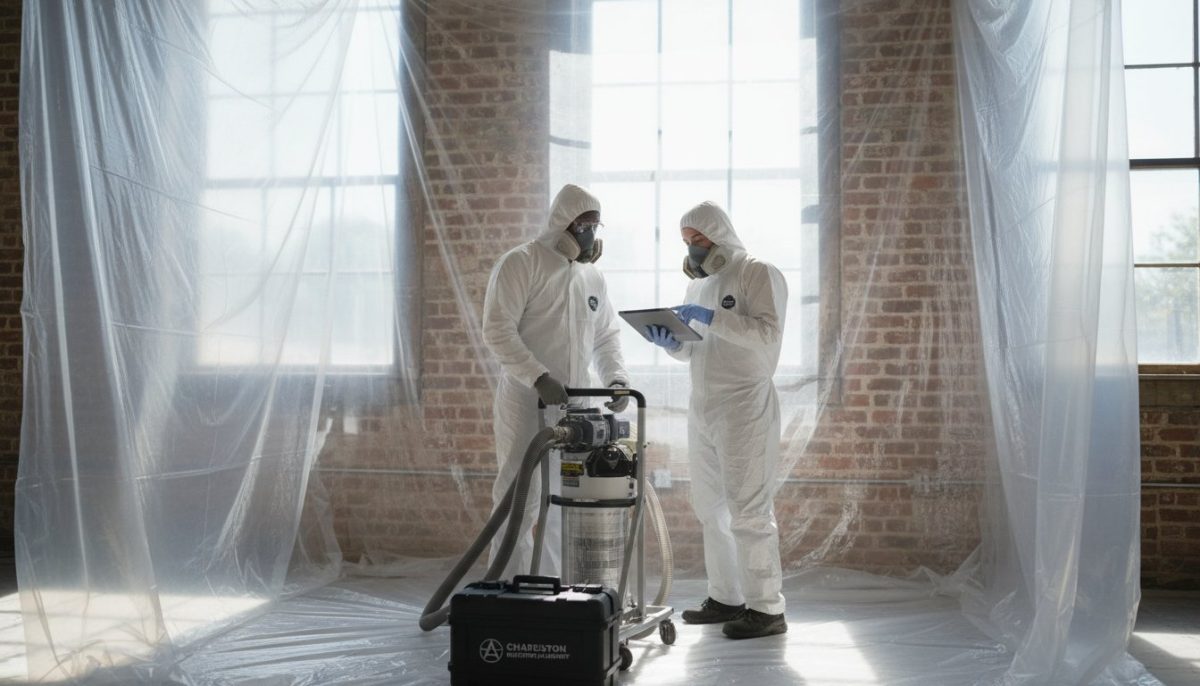
A single oversight in your 2026 renovation plan can trigger SCDES penalties exceeding $25,000 per day. You’ve likely felt the weight of potential delays or the anxiety of hidden asbestos and lead paint surfacing after the first wall comes down. It’s a valid concern because structural integrity means nothing if the site remains toxic for following trades. We understand that managing a commercial asset requires more than just vision; it demands a disciplined approach to safety and rigorous risk mitigation.
This professional guide delivers the technical roadmap you need for hazardous material abatement south carolina. We’ve compiled the essential data to help you identify, contain, and remediate contaminants during complex structural projects. You’ll learn how to secure full regulatory compliance, minimize environmental impact, and protect your budget from the 15% cost overruns typically caused by late-stage contaminant discovery. We’ll examine the latest 2026 regulatory shifts, specific containment protocols for industrial sites, and the precise steps required to eliminate liability through certified remediation.
Key Takeaways
- Understand the critical distinction between basic cleanup and technical remediation to ensure the safety and structural integrity of your project site.
- Learn to identify high-risk contaminants and the difference between friable and non-friable materials found across South Carolina’s diverse building stock.
- Master the systematic phases of hazardous material abatement south carolina, from the initial survey and laboratory testing to secure containment and disposal.
- Navigate the complex hierarchy of safety standards and environmental regulations enforced by the EPA, OSHA, and the South Carolina Department of Environmental Services (SCDES).
- Discover how to evaluate professional partners who possess the technical expertise to manage abatement within the context of the broader structural demolition process.
Understanding Hazardous Material Abatement in South Carolina
Hazardous material abatement south carolina is a technical engineering process. It’s not a simple janitorial task. Abatement focuses on the controlled identification, containment, and permanent removal of toxic substances such as asbestos, lead, and chemical residues. While cleanup might address visible debris, professional remediation utilizes specialized equipment to eliminate microscopic threats. Property owners must prioritize these actions before any structural disturbance occurs. This proactive approach prevents the release of carcinogens and avoids the legal complications that arise from improper handling.
The Role of Abatement in Property Safety
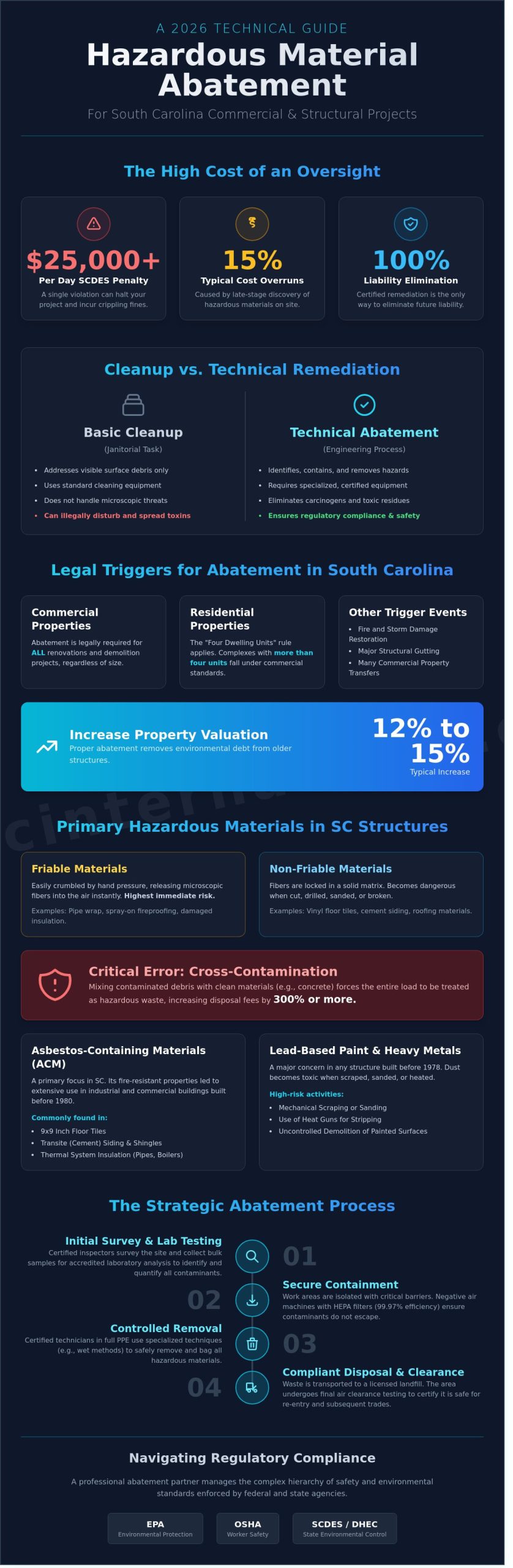
Effective abatement stops toxic particles from migrating into the local environment. During a project, contractors use negative air machines equipped with HEPA filters that capture 99.97% of particles as small as 0.3 microns. These 2026 safety standards ensure that the air quality remains safe for both the work crew and the surrounding community. By removing these hazards, owners protect the health of future occupants and ensure the structure complies with modern environmental codes. It’s a critical step in maintaining the integrity of the building’s ecosystem.
When is Abatement Legally Required?
South Carolina law mandates specific triggers for professional intervention. The South Carolina Department of Health and Environmental Control (DHEC) requires abatement for all commercial renovations and every demolition project. For residential properties, the “four dwelling units” rule applies. If a residential complex contains more than four units, it’s regulated under the same strict standards as commercial sites. Other trigger events include:
- Fire and Storm Damage: Restoration after events like the high-wind storms of late 2024 often reveals hidden toxins.
- Structural Gutting: Any project that removes load-bearing elements or significant interior finishes.
- Property Transfers: Many lenders require a clean environmental report before financing a 2026 real estate transaction.
Investing in professional hazardous material abatement south carolina reduces long-term liability. It also typically increases property valuation by 12% to 15% by removing the environmental debt associated with older structures. Precision in these early stages ensures the project stays on schedule and avoids regulatory fines that can exceed $25,000 per violation.
Primary Hazardous Materials Found in Structural Environments
Identifying contaminants requires a technical understanding of South Carolina’s construction history. Buildings erected before 1980 represent a high risk category for hazardous material abatement south carolina projects. The age of a structure serves as the most reliable indicator of what lies behind the drywall or under the flooring. In the Upstate, legacy textile mills often harbor different chemical signatures than the historic coastal properties in Charleston or the mid-century commercial hubs in Columbia.
Materials are classified by their stability. Friable materials, like spray-applied fireproofing or pipe wrap, can be crumbled by hand pressure. This releases microscopic fibers into the breath zone instantly. Non-friable materials, such as vinyl floor tiles or cement siding, hold fibers in a solid matrix. These are safer until they’re disturbed by mechanical grinding, drilling, or fire damage. A critical mistake in demolition is mixing “inert” debris like clean concrete with regulated contaminants. Once cross-contamination occurs, the entire 20-ton load must be treated as hazardous waste. This error typically increases disposal fees by 300 percent or more.
Asbestos-Containing Materials (ACM)
Asbestos remains the central focus for hazardous material abatement south carolina projects. It’s frequently found in 9×9 floor tiles, transite siding, and thermal system insulation. Because of its fire-resistant properties, it was used extensively in industrial facilities across the state. For a deeper technical dive into compliance, consult our complete guide to asbestos removal in South Carolina.
Lead-Based Paint and Heavy Metals
Lead-based paint is a primary concern in structures built before 1978. When workers use mechanical scraping or heat guns, they create toxic dust that settles in HVAC systems. Beyond lead, older industrial sites often contain mercury in thermostats or PCBs in fluorescent light ballasts. These require specialized handling to prevent soil contamination. You can find detailed protocols in our overview of safe lead paint removal services.
Biological Hazards and Mold
South Carolina’s average summer humidity of 72 percent creates an ideal environment for rapid mold growth. Mold isn’t just an aesthetic issue; it can compromise the structural integrity of wood framing over time. Property owners should seek professional mold remediation in South Carolina rather than attempting unverified methods. Common DIY mold removal myths often lead to the spread of spores and eventual structural failure. If you’re managing a complex renovation, our team can provide a comprehensive structural assessment to identify these risks before work begins.
The Strategic Abatement Process: From Containment to Disposal
Executing a successful hazardous material abatement south carolina project requires a rigid, three-phase framework that prioritizes structural integrity and environmental safety. It’s not a simple demolition job; it’s a controlled engineering operation. Before any physical work begins, a detailed inventory of hazardous substances is required. This data-driven approach ensures that every gram of toxic material is accounted for from the initial identification to the final disposal at a certified facility.
A systematic approach guarantees that property owners remain compliant with South Carolina Department of Environmental Services (SCDES) regulations. Precision is the standard. If the initial survey or the engineering controls fail, the entire project’s safety is compromised. We focus on four critical pillars:
- Detailed laboratory testing of all suspected materials.
- Isolation of the work area through physical barriers.
- Constant negative air pressure to trap microscopic fibers.
- Documented clearance testing to prove the site is safe for re-entry.
Phase 1: Inspection and Containment
The process starts with a comprehensive lead paint test or a certified asbestos survey to map out the exact location of contaminants. Once identified, teams establish high-strength, 6-mil poly-containment zones. These areas are sealed to prevent cross-contamination. Technicians install HEPA-filtered air filtration systems that maintain negative air pressure, scrubbing the air and capturing 99.97% of particles as small as 0.3 microns.
Phase 2: Removal and Remediation
Removal requires precision. Teams utilize wet-method techniques to saturate materials, which suppresses dust and keeps fibers from becoming airborne. This surgical extraction allows for the removal of hazardous components without damaging the building’s primary shell. During selective demolition, contaminated sections are isolated and removed under constant monitoring to ensure the structural stability of the facility remains intact throughout the hazardous material abatement south carolina process.
Phase 3: Waste Management and Disposal
All waste is subjected to strict labeling and double-bagging protocols. Materials are transported directly to SCDES-permitted landfills authorized to accept toxic waste. We maintain a rigorous chain of custody for every load, providing property owners with a documented paper trail. The project only concludes after final clearance testing; this laboratory-verified proof confirms that the site is safe for re-occupancy and complies with all state environmental regulations.
Navigating Regulatory Compliance and Safety Standards
Property owners must understand that hazardous material abatement south carolina is governed by a strict hierarchy of federal and state oversight. The Environmental Protection Agency (EPA) sets the baseline for environmental protection, while the Occupational Safety and Health Administration (OSHA) dictates rigorous site safety protocols. In South Carolina, the Department of Environmental Services (SCDES) assumed all environmental regulatory duties on July 1, 2024, following the restructuring of the former DHEC. This transition means compliance now requires precise coordination with the SCDES Bureau of Air Quality and the Bureau of Land and Waste Management.
The Resource Conservation and Recovery Act (RCRA) Subtitle C establishes a “cradle-to-grave” liability framework. This means your responsibility for hazardous waste doesn’t end when the material leaves your property; it stays with the property title until the waste is neutralized or destroyed. Hiring personnel with valid South Carolina licenses for asbestos or lead oversight isn’t just a safety choice. It’s a legal necessity to ensure the project remains defensible during a state audit or if a future liability claim arises. Documentation acts as your primary shield. Every manifest, air sample result, and worker certification must be archived to prove the project followed the South Carolina Hazardous Waste Management Act.
SCDES Bureau of Air Quality Regulations
SCDES Regulation 61-86.1 requires a written notification at least 10 working days before any renovation or demolition begins, regardless of whether asbestos is suspected. You must use specific waste shipment records for all regulated materials. Failure to provide these documents can result in civil penalties exceeding $10,000 per day of violation. Proper planning ensures that all disposal manifests are signed by the generator, the transporter, and the landfill operator, closing the compliance loop.
OSHA Standards for Worker Protection
OSHA Standard 29 CFR 1926.1101 requires specific engineering controls like HEPA filtration and negative pressure enclosures for hazardous material abatement south carolina projects. Teams must wear appropriate PPE, often including respirators and impermeable suits, based on the initial exposure assessment. A designated “Competent Person” must remain on-site to conduct daily inspections and oversee air monitoring. These protocols ensure that Permissible Exposure Limits stay below 0.1 fibers per cubic centimeter for asbestos, protecting both the workers and the surrounding environment.
Choosing a Professional Abatement Partner in South Carolina
Selecting a contractor for hazardous material abatement south carolina requires more than a simple price comparison. Property owners must verify South Carolina Department of Environmental Services (SCDES) certifications and comprehensive liability insurance that specifically covers environmental pollutants. A partner who understands the full demolition process ensures that hazardous removal doesn’t stall subsequent structural work. This integrated knowledge prevents the common 15% to 20% project delays caused by miscommunication between separate abatement and demolition crews.
Effective hazardous material abatement south carolina projects rely on clear financial boundaries. Fixed-price contracts provide the strongest safeguard against the financial volatility of 2026 construction markets. Unlike time and materials agreements, a fixed-price proposal forces the contractor to conduct thorough initial surveys, including bulk sampling and site assessments. This transparency eliminates hidden fees and ensures the project stays within the initial capital allocation.
The TSIAC Advantage: Engineering Precision
TSIAC International brings over 15 years of technical experience to complex structural and hazardous projects. Our team specializes in commercial interior gutting where precision is non-negotiable for preserving structural integrity. We don’t just clear sites; we manage resources. By recycling up to 85% of wood, metal, and plastic debris, we significantly reduce landfill reliance and help clients meet modern sustainability targets.
Securing Your Project Estimate
Obtaining an accurate quote starts with a detailed site walkthrough. Owners should provide existing environmental reports, building age documentation, and blueprints. We use this data to build a comprehensive abatement plan that accounts for every square foot of contaminated material. Clear documentation ensures the final proposal reflects the actual scope of work, leaving no room for mid-project surprises.
Precision and safety are the foundations of every successful redevelopment. Contact TSIAC International for a professional abatement consultation to secure your 2026 project timeline and ensure your property meets all regulatory standards with engineering-grade accuracy.
Executing Safe Abatement Standards for Your Next Project
Managing a structural environment in 2026 requires more than simple awareness; it demands a technical approach to safety and rigorous compliance. Property owners must navigate the strict standards set by the SCDES and EPA to ensure every stage of the process, from initial containment to final disposal, meets legal mandates. Success hinges on identifying specific risks like asbestos or lead early and employing a comprehensive environmental recycling program to mitigate long-term liability. When you prioritize hazardous material abatement south carolina, you aren’t just cleaning a site; you’re protecting a high-value asset and ensuring public safety.
TSIAC International brings 15+ years of abatement and demolition experience to every project, ensuring your site remains fully compliant with all 2026 environmental protocols. We don’t just remove waste; we manage it through a specialized recycling system that reduces your project’s total footprint. Our team handles the technical complexities so you can focus on the next phase of your development with total confidence.
Request a Professional Abatement Quote from TSIAC International
Your project deserves the precision and safety that only a seasoned partner provides.
Frequently Asked Questions
What is the difference between hazardous material abatement and remediation?
Abatement refers to the physical removal or permanent encapsulation of a specific hazard to eliminate immediate exposure risks. Remediation involves a broader scope of cleaning a site to safe environmental levels, often including long-term processes like groundwater filtration. In South Carolina, abatement projects follow SCDHEC Regulation 61-86.1 protocols, while remediation typically addresses systemic contamination under EPA Superfund guidelines. Our technical teams focus on the precise extraction of these materials to ensure structural integrity remains intact.
How much does hazardous material abatement cost in South Carolina?
Hazardous material abatement south carolina costs typically range from $8 to $15 per square foot for asbestos removal in 2026. A standard lead paint project for a 1,500 square foot residential property averages $12,000, while industrial projects often exceed $50,000 depending on site complexity. These figures reflect 2024 RSMeans Construction Cost Data for the Southeast region. Precise estimates require a site survey to account for specialized labor, containment equipment, and disposal fees.
Can I perform asbestos or lead removal myself on my own property?
You can legally remove asbestos from your own single-family home in South Carolina under specific SCDHEC exemptions, but it’s rarely a safe choice. Commercial property owners must hire licensed contractors according to OSHA 1926.1101 standards to protect workers and the public. DIY attempts often lead to cross-contamination, which increases final cleanup costs by 40 percent compared to professional intervention. Safety is the priority because microscopic fibers stay airborne for 72 hours after being disturbed.
How long does a typical hazardous material abatement project take?
A typical residential abatement project takes 3 to 7 business days to complete from setup to final clearance. Larger industrial facilities or complex commercial sites often require 14 to 21 days for full decontamination and structural cleaning. This timeline includes the mandatory 10-day SCDHEC notification period and the 24-hour waiting period for final air clearance testing. We maintain a fegyelmezett schedule to ensure your primary construction timeline experiences minimal disruption.
What are the notification requirements for demolition in South Carolina?
South Carolina law requires a 10-working-day notification to SCDHEC before any demolition or renovation begins on regulated structures. You must submit Form DHEC 0803 along with the applicable fees, which range from $50 to $1,000 based on the project’s scale. Failure to provide this notice results in administrative fines that start at $1,000 per day. This rule applies to all commercial projects even if your initial survey doesn’t identify hazardous materials.
How do I know if my building contains hazardous materials before starting a renovation?
You must conduct a professional hazardous material survey using an SCDHEC-licensed inspector before starting any physical work. Buildings constructed before the 1978 lead paint ban or the 1989 EPA asbestos restrictions are high-risk sites. Inspectors use Polarized Light Microscopy to identify fibers in 95 percent of building material samples taken from the site. This technical assessment provides a definitive inventory of all regulated substances and forms the basis of our safety plan.
What happens if hazardous materials are discovered after a project has already started?
Stop all construction activity immediately and evacuate the work area if you find suspicious materials during a project. You should establish a 25-foot exclusion zone and seal the HVAC system to prevent dangerous fiber migration through the building. Contact a licensed professional to perform emergency air monitoring and bulk sampling. Resuming work without a formal clearance certificate violates South Carolina safety regulations and risks 100 percent of your project’s liability insurance coverage.
Are there specific landfills in South Carolina for hazardous waste disposal?
Hazardous waste must go to one of the 12 permitted Class 3 landfills in South Carolina that are engineered to accept friable asbestos. Facilities like the Hickory Hill Landfill or the Richland County Landfill have specific cells designed for hazardous material abatement south carolina waste. Every shipment requires a detailed waste shipment record signed by the generator, transporter, and disposal site operator. These documents must be retained for 30 years to ensure full regulatory compliance.
