
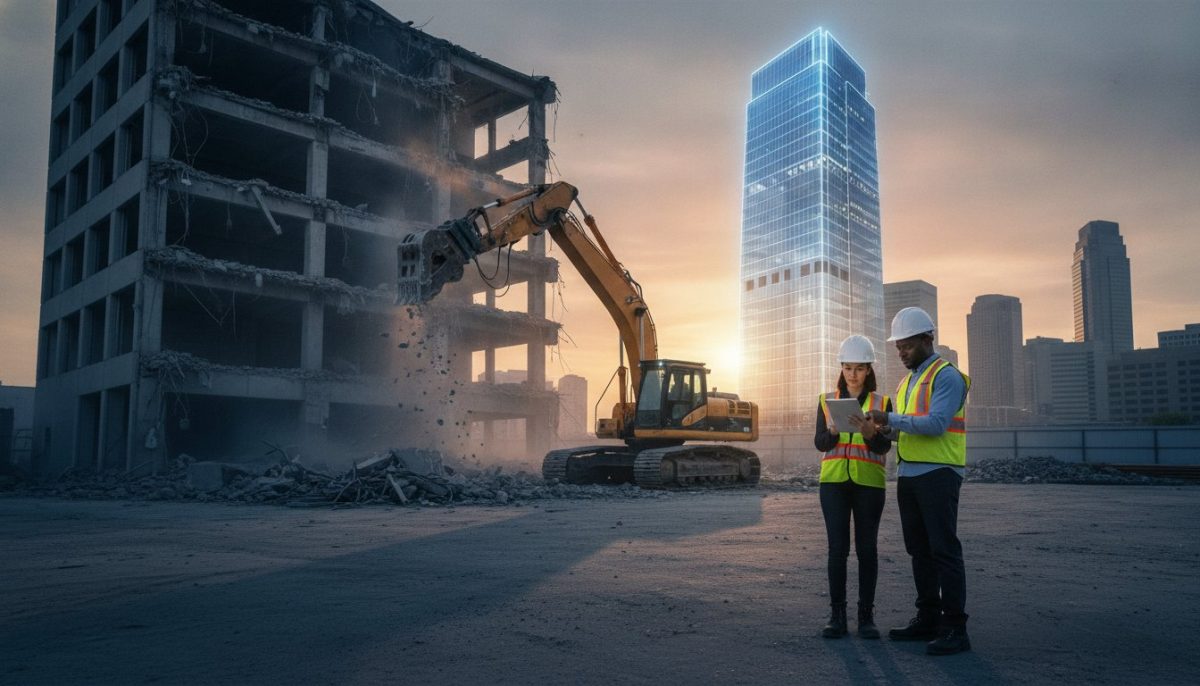
In the current regulatory climate, a commercial demolition permit isn’t just an administrative hurdle; it’s a high-stakes legal shield against six-figure environmental fines. Successfully managing the commercial demolition process south carolina requires more than just heavy machinery. It demands a surgical approach to the 2026 South Carolina Department of Environmental Services (SCDES) mandates. You likely understand that missing a single asbestos notification window can stall a multi-million dollar redevelopment before the first excavator even arrives on-site. The uncertainty surrounding selective versus structural needs only adds to the project’s complexity.
This guide provides a comprehensive technical blueprint to help you navigate the transition from a standing structure to a shovel-ready site without the looming threat of regulatory non-compliance. We’ll outline the mandatory 10-day SCDES notification protocols and the rigorous safety standards required for hazardous material abatement. By the end of this article, you’ll have a clear timeline for project commencement and a strategy for full regulatory documentation. We’re covering everything from interior gutting to structural removal, ensuring your site is cleared, documented, and ready for its next phase of construction with methodical precision.
Key Takeaways
- Master the mandatory 10-day SCDES notification protocols and engineering survey requirements to ensure full regulatory compliance before work begins.
- Identify the critical sequence for asbestos and lead abatement to mitigate environmental liability and avoid costly project interruptions.
- Evaluate the technical advantages of total structural demolition versus the surgical precision of selective demolition for complex interior renovations.
- Implement sustainable debris management strategies, including on-site material recovery, to reduce landfill tipping fees and improve project ROI.
- Navigate the comprehensive commercial demolition process south carolina to transition seamlessly from a standing structure to a site ready for new construction.
The Pre-Demolition Phase: Surveys and SCDES Compliance
The commercial demolition process south carolina isn’t merely a physical act of destruction; it’s a sophisticated engineering sequence that requires meticulous foresight and technical precision. Before any heavy equipment arrives on-site, contractors must navigate a labyrinth of state regulations and structural assessments. This initial phase sets the tone for the entire project, ensuring that the transition from a standing structure to a clear site happens without legal or physical catastrophe. Successful project managers treat this phase as the most critical part of the Demolition process, where data gathering dictates the safety of every subsequent step.
As of 2026, the South Carolina Department of Environmental Services (SCDES) oversees all demolition activities across the state. Navigating their ePermitting system is the first technical hurdle for any contractor. This digital platform centralizes regulatory filings, requiring precise data on structure size, age, and previous use. Concurrent with state filings, utility coordination is paramount. Contractors must secure written “cut letters” from power, gas, and water providers to confirm that all service lines are capped or removed. This prevents hazardous discharges or accidental explosions during the initial structural breach.
The 10-Day SCDES Notification Rule
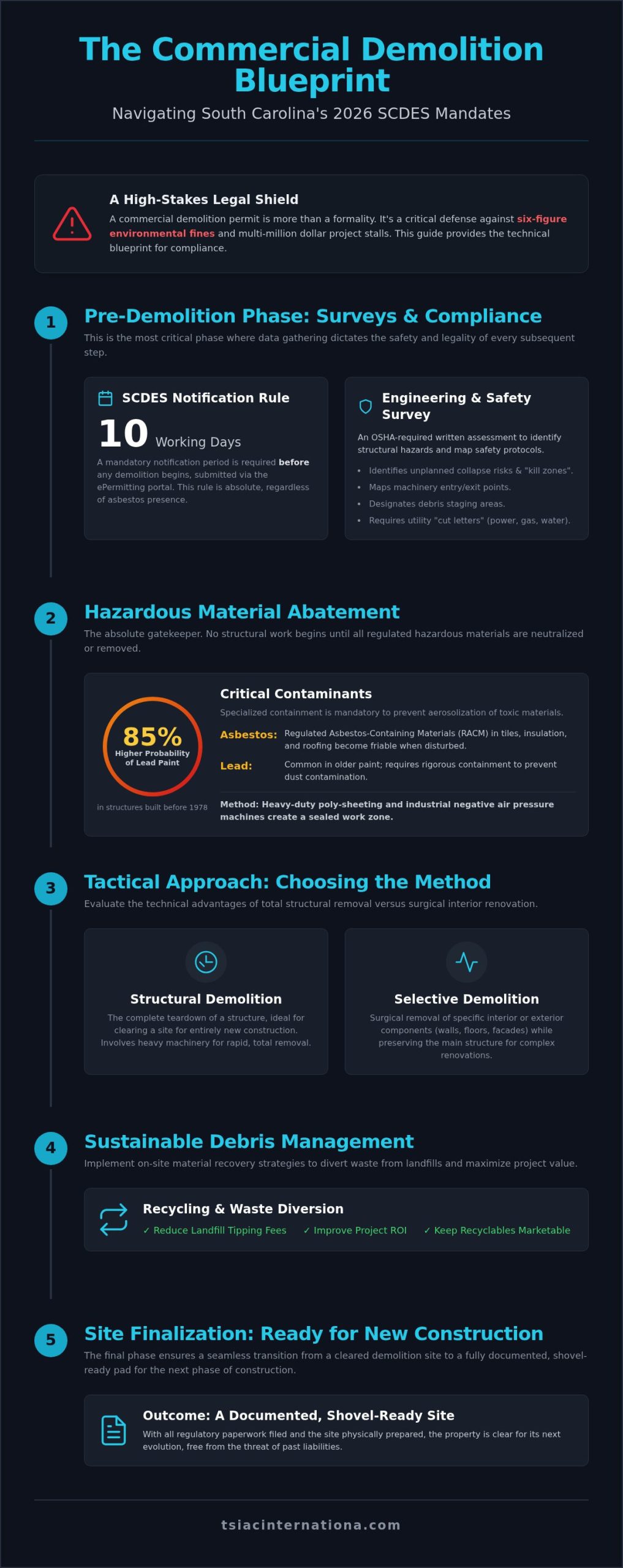
SCDES Regulation 61-86.1 mandates a 10-working-day notification period before any demolition begins. This rule is absolute and applies regardless of whether an initial inspection found asbestos. You’ll need to submit detailed documentation through the ePermitting portal, including the facility owner’s information, valid contractor licensing, and a thorough description of the structure’s physical characteristics. Skipping this step or engaging in unpermitted activities like “structural burns” for training purposes without specific clearance carries severe financial penalties. These fines can easily exceed the cost of the demolition itself, making the waiting period a non-negotiable component of your project timeline.
Engineering Surveys and Site Safety Plans
OSHA standards require a written structural assessment before any load-bearing members are removed. This survey identifies the potential for unplanned collapses and maps out “kill zones” where debris fall is most likely. The Engineering Survey is the foundation of site safety. By establishing secure perimeters and identifying hazardous conditions like weakened floors or unstable walls, contractors protect both their crew and the surrounding property. A well-executed safety plan includes several key components:
- Mapping of all entry and exit points for heavy machinery to avoid site congestion.
- Designation of debris staging areas to facilitate efficient material sorting.
- Detailed vibration monitoring plans for projects adjacent to active commercial structures.
- Identification of underground storage tanks or hidden vaults that could compromise soil stability.
Hazardous Material Abatement: Asbestos and Lead Protocols
Abatement is the absolute gatekeeper of the commercial demolition process south carolina. You can’t initiate structural teardowns until every gram of regulated hazardous material is neutralized or removed. This phase prevents the aerosolization of toxic fibers and dust, protecting both your crew and the local community from environmental exposure. Proper abatement protocols also ensure that the rest of the building materials remain uncontaminated, supporting federal goals for the Sustainable Management of C&D Materials by keeping recyclables clean and marketable.
Identifying Regulated Asbestos-Containing Materials (RACM) is a primary technical challenge in older commercial structures. These materials, often found in floor tiles, pipe insulation, and roofing felts, become friable when crushed. Similarly, structures built before 1978 have an 85% higher probability of containing lead-based paint. To manage these risks, specialized containment is mandatory. We use heavy-duty poly-sheeting and industrial negative air pressure machines to ensure that no contaminated air escapes the work zone during the remediation process.
Asbestos Abatement Execution
The execution of asbestos removal follows a rigid, four-step methodology to ensure site safety. It’s a precise operation that leaves no room for error or oversight.
- Step 1: A licensed South Carolina inspector conducts professional testing and a comprehensive site survey.
- Step 2: Crews establish regulated work areas with sealed barriers and multi-stage decontamination units for personnel.
- Step 3: Technicians use wet-method removal techniques, saturating materials with amended water to prevent fiber release at the source.
- Step 4: Independent air clearance testing confirms the environment is safe before general demolition crews enter the site.
Lead and Toxic Material Disposal
Handling lead-coated steel and contaminated drywall requires a documented chain of custody. You can’t treat these materials as standard construction debris. Every ton of hazardous waste must be tracked from the site to a certified disposal facility, providing a paper trail that shields property owners from future litigation. Professional asbestos removal south carolina services specialize in this high-stakes documentation. If you’re managing a complex site with multiple hazardous variables, partnering with an experienced abatement specialist is the most effective way to maintain your project schedule while staying fully compliant with SCDES regulations.
Structural vs. Selective Demolition: Tactical Approaches
Choosing the right tactical approach is a decision driven by the eventual end-use of the property. Whether it’s a total structural collapse or a surgical interior strip-out, the commercial demolition process south carolina requires specialized equipment and a deep understanding of load-bearing physics. Total structural demolition involves the controlled leveling of an entire building, typically utilized when a site is slated for ground-up redevelopment. Conversely, selective demolition targets specific components or wings, allowing the rest of the facility to remain operational or structurally intact for future expansion.
Managing the commercial demolition process south carolina involves a calculated balance between raw power and engineering finesse. To execute these maneuvers with precision, we deploy high-reach excavators and hydraulic shears. These advanced tools allow for “top-down” demolition, which is significantly safer in tight environments where traditional wrecking balls are too imprecise. Hydraulic shears are particularly effective for processing metal framing and structural steel on-site, converting massive beams into manageable scrap for immediate recycling and transport.
Surgical Interior Gut-Outs
Stripping a building to its structural shell requires a delicate touch despite the heavy nature of the work. Our teams use precision techniques to remove drywall, acoustic ceilings, and multi-layered flooring without compromising the building’s exterior envelope. A critical aspect of this work is the preservation of MEP (Mechanical, Electrical, Plumbing) systems. In many tenant improvement projects, these systems are carefully salvaged or bypassed to reduce future construction costs. Utilizing professional commercial interior gutting services is essential for urban redevelopment where preserving the architectural facade is a priority.
High-Scale Structural Removal
For total teardowns, we follow a sequential demolition strategy. This methodology involves taking the building down in the reverse order of its construction, ensuring that each structural member is removed only when the load it carries has been safely eliminated. In sensitive commercial zones, we implement rigorous vibration monitoring and dust suppression systems. High-pressure water misting cannons keep particulates grounded, while seismic sensors ensure that neighboring foundations aren’t disturbed. Once the main shell is neutralized, we focus on concrete removal and the sorting of metal framing, ensuring that every ton of material is processed for its highest recovery value.
Sustainable Debris Management: Recycling and Waste Diversion
In the current fiscal landscape, material recovery is no longer an afterthought; it’s a primary driver of project ROI. The commercial demolition process south carolina has evolved into a sophisticated resource management operation where the goal is to minimize landfill contributions. By treating a structure as a source of raw materials rather than a pile of waste, contractors can significantly offset disposal costs. Effective on-site recovery hinges on the methodical separation of structural timber, ferrous and non-ferrous metals, and high-volume aggregates like concrete and masonry.
Metal recovery offers the highest immediate salvage value, with steel, copper, and aluminum being the most sought-after commodities. Structural steel beams and copper piping from MEP systems are processed on-site for direct transport to local foundries. Wood recycling also plays a vital role in 2026 sustainability standards. Clean structural timber is often diverted to specialized facilities that convert it into mulch or biomass fuel, avoiding the higher tipping fees associated with mixed construction debris. This systematic approach ensures that high-volume materials stay out of South Carolina landfills, which are increasingly burdened by municipal solid waste.
On-Site Sorting and Hauling
Maximizing material purity requires the establishment of “source separation” zones before structural teardown begins. By designating specific areas for metal, wood, and concrete, we prevent cross-contamination that would otherwise downgrade the value of the recyclables. The logistics of hauling are equally critical. We coordinate with licensed recycling centers to ensure that every load is categorized correctly, which is essential for accurate cost tracking. Industry data indicates that on-site sorting of metal, clean wood, and aggregates can reduce landfill tipping fees by 35% to 45%. This level of efficiency can reduce total project costs by up to 20% compared to traditional “load and dump” methods.
Environmental Stewardship in 2026
Modern commercial developments frequently require LEED certification, which mandates high waste diversion rates. Sustainable practices in the demolition process south carolina are the first step in achieving these green building credits. We provide comprehensive documentation of all diverted materials, which serves as a critical component of corporate social responsibility (CSR) reporting for property owners. This data-driven approach proves that your project has minimized its carbon footprint from the very first phase. If you’re looking to optimize your site’s environmental impact, our recycling services provide the technical framework needed to meet these rigorous 2026 standards.
Site Finalization: Preparing for New Construction
Site finalization represents the critical transition point where the focus shifts from mechanical destruction to precision site preparation. Once the vertical superstructure is removed, the commercial demolition process south carolina continues below the surface. This phase involves the systematic extraction of concrete footings, deep foundations, and any abandoned underground utility vaults. Leaving these elements in the soil can compromise the structural integrity of future builds, so their complete removal is a non-negotiable requirement for a truly clean site.
A significant trend in 2026 sustainable debris management is the use of mobile jaw crushers on-site. Instead of hauling heavy concrete debris to a landfill, we process old foundations into usable structural fill or road base right where they sit. This eliminates the transport fees associated with heavy hauling and provides the next construction team with high-quality, recycled aggregate. Rough grading follows this step, where we ensure the land is leveled and sloped correctly to prevent drainage issues that could delay the foundation pour for the new development.
From Demolition to Pad-Ready
The efficiency of a project often hinges on the continuity of the workflow. Utilizing an “all-in-one” contractor who manages everything from initial hazardous material abatement to final rough grading prevents the “silo effect” that causes delays. When the same team that removed the building also prepares the pad, there’s a seamless transfer of site data regarding soil conditions and compaction requirements. Ensuring the site meets specific density and compaction standards is vital for the longevity of the new structure’s foundation. This methodical approach to site turnover is why tsiac international charleston remains a preferred partner for developers who require a site that’s truly ready for the next phase of construction.
Final Regulatory Close-Out
The physical clearing of the land is only half the battle; the commercial demolition process south carolina isn’t legally complete until the paperwork is finalized. This involves securing and organizing all final disposal manifests and abatement clearance letters. These documents prove that every ton of hazardous material was handled according to SCDES Regulation 61-86.1 and that all recyclables were tracked accurately. Closing out permits with the SCDES and local municipal authorities requires a high level of administrative precision. We provide property owners with a comprehensive “clean site” documentation package, which serves as a vital liability shield and a green light for the construction team to break ground.
Secure Your Site’s Future with Regulatory Precision
Success in the 2026 redevelopment market hinges on the precision of your initial site clearing. You’ve seen that the commercial demolition process south carolina is no longer a simple matter of mechanical force. It’s a highly regulated engineering sequence where SCDES compliance, specialized abatement, and methodical material recovery dictate your project’s ultimate ROI. By prioritizing these technical phases, you protect your investment from environmental liability and ensure a seamless transition to new construction.
Navigating these complexities requires a partner with deep industry roots and a commitment to sustainable execution. TSIAC International leverages 15+ years of South Carolina project experience and specialized asbestos and lead abatement certifications to deliver pad-ready sites. Our focus on environmental stewardship is evidenced by our ability to achieve a 90%+ waste diversion rate through on-site recycling of wood, metal, and plastic. Don’t leave your project’s foundation to chance. Contact TSIAC International for a Professional Site Assessment to ensure your site is cleared with the technical accuracy your next build deserves. We’re ready to help you break ground with confidence.
Frequently Asked Questions
Do I need an asbestos survey if my building was built after 1980?
Yes, you must conduct a certified asbestos survey regardless of the structure’s age. SCDES Regulation 61-86.1 mandates a thorough inspection for all commercial structures and most residential projects before any demolition or renovation begins. Asbestos was not entirely banned in 1980; it’s still frequently found in modern roofing materials, floor tiles, and mastics. Skipping this step can lead to significant environmental fines and immediate project shutdowns during the commercial demolition process south carolina.
How long does the commercial demolition process typically take in South Carolina?
A standard project timeline typically ranges from four to eight weeks, depending on the structure’s complexity and hazardous material load. You must account for the mandatory 10-working-day SCDES notification period before any physical work starts. Hazardous material abatement can add one to three weeks to the schedule, while the actual structural teardown and site clearing usually require another two to four weeks. Complex utility disconnections can extend this schedule further.
What is the 10-day rule for SCDES demolition notification?
The 10-day rule requires contractors to submit a formal notification to the South Carolina Department of Environmental Services at least 10 working days before demolition begins. This waiting period allows the state to review the asbestos survey and project plan. You can’t bypass this requirement even if the building is confirmed to be asbestos-free. Failure to wait the full 10 business days before mobilizing heavy equipment results in immediate regulatory non-compliance and potential financial penalties.
Can I perform selective interior demolition without a structural permit?
You can often perform non-structural interior gutting without a full structural demolition permit, but you still need local building permits and SCDES asbestos clearance. If your project involves removing load-bearing walls or modifying the building’s envelope, a structural permit is mandatory. Always verify specific requirements with local municipal building departments, as urban zones often have stricter codes regarding waste management and fire safety systems during the interior demolition phase.
What happens to the materials removed during a commercial gut-out?
Materials removed during a commercial gut-out are sorted on-site to maximize recovery and reduce landfill fees. Metal framing, copper wiring, and aluminum ductwork have high salvage value and are sent to local recycling facilities. Clean wood and certain plastics are diverted to biomass or specialized processing centers. By implementing source separation, we aim for a waste diversion rate of 90% or higher, which supports LEED certification and reduces the project’s overall environmental footprint.
How much does commercial demolition cost per square foot in 2026?
Industry averages for commercial demolition in the South Carolina market generally range from $20 to $35 per square foot for reinforced concrete and structural steel buildings. These costs fluctuate based on the structure’s height, the presence of hazardous materials, and the complexity of the selective demolition required. Factors like high landfill tipping fees, which reached $46 per ton for construction debris in some counties in 2026, also influence the final project budget.
Is a separate permit required for hazardous material abatement in SC?
Yes, hazardous material abatement requires its own specific notification and oversight under SCDES rules. While the demolition notification covers the structural teardown, any regulated asbestos removal must be filed separately based on the quantity of material. For projects exceeding 160 square feet of asbestos, a 10-day notification is required. Smaller removals might only require a two-day or four-day notice, but all must be documented to maintain a legal chain of custody for the waste.
What are the risks of hiring an unlicensed demolition contractor?
Hiring an unlicensed contractor exposes property owners to massive financial liability and potential criminal negligence charges. If an unlicensed crew mishandles asbestos or lead, the building owner is held legally responsible for the cleanup costs and environmental fines. Additionally, unlicensed operators often lack the specialized insurance needed for high-risk structural work. This leaves you vulnerable to lawsuits if an accident occurs on-site during the commercial demolition process south carolina, potentially stalling your redevelopment for years.
